
I was very surprised Pope Leo was elected the 2nd Day of the Conclave. With so many unknown Cardinals, I thought it could take a week.
But the Lord does work in mysterious ways. Once the Cardinals are cut off from the World completely in the Conclave that started May 7, they depend on the Holy Spirit to guide them in making such an important decision. The Holy Spirit acted fast this Time.
Donald Trump posted this image of himself on his Truth Social Website 3 Days before the Conclave started:

He already had a Vatican like Curia
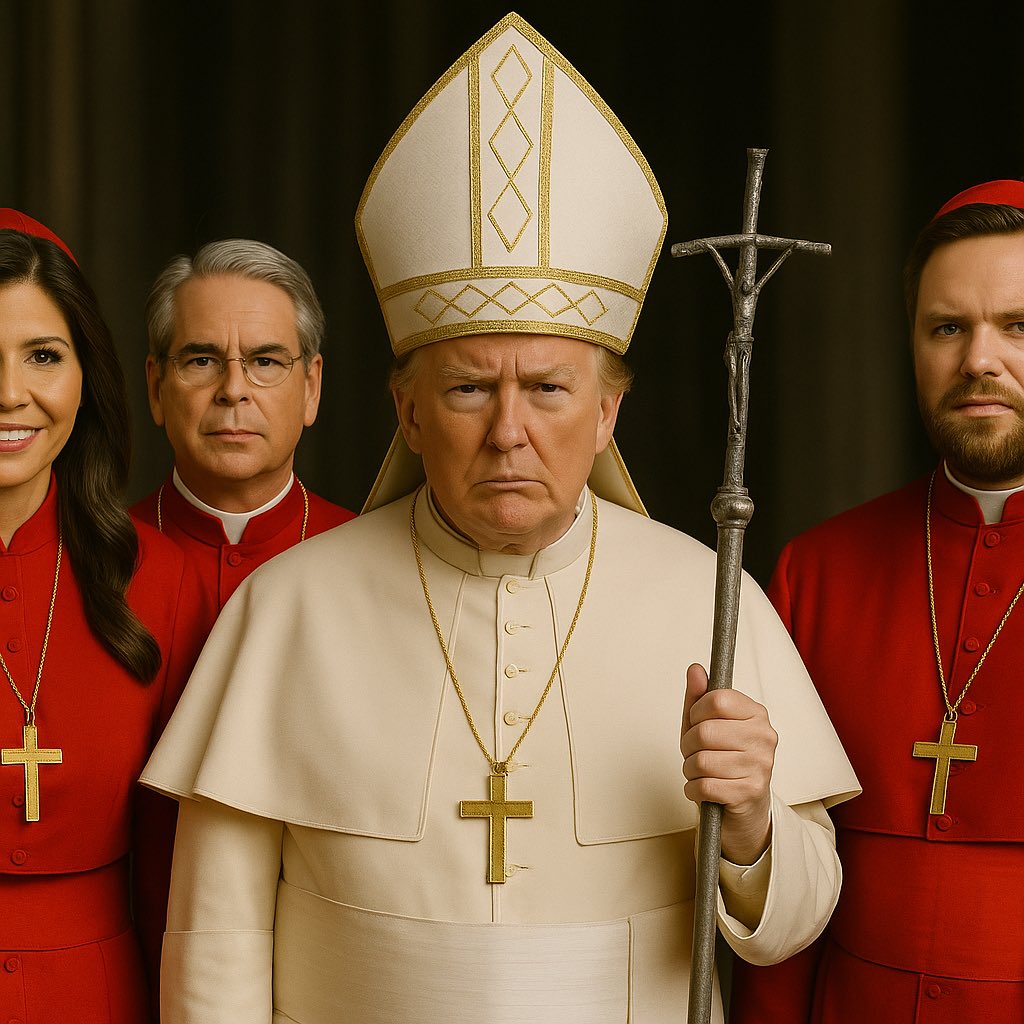
Most probably all the Cardinals were talking about Trump posing as Pope the 1st Day of the Conclave.
The Holy Spirit moved quickly having the Cardinals realize the Cardinal having Pastoral Experience ministering to the poor, Vatican experience as an insider, and an American, was the best possible choice to speak to Trump the anti-Pope and anti-Christ in English, so that nothing would be lost in translation. He was elected with the necessary 2/3 consensus in record Time, the 2nd Day of the Conclave.
This is the 1st homily Pope Leo gave at his 1st Mass as Pope for the Cardinals. Reading it, he is following in the footsteps of Pope Francis, and I expect Leo XIV to use the Bully Pulpit like no Pope before him in our Lifetimes.

Leo spoke briefly in English before his homily, saying:
“I want to repeat the words from the Responsorial Psalm: ‘I will sing a new song to the Lord, because He has done marvels,’ and indeed, not just with me but with all of us.
“My brother Cardinals, as we celebrate this morning, I invite you to reflect on the marvels the Lord has done, the blessings that the Lord continues to pour out on all of us through the Ministry of Peter.
“You have called me to carry that cross, and to carry out that mission, and I know I can rely on each and every one of you to walk with me, as we continue as a Church, as a community of friends of Jesus, as believers, to announce the Good News, to announce the Gospel.”
During his homily, delivered in Italian, Leo said that Christians must serve a world that is often hostile to their beliefs.
“Even today, there are many settings in which the Christian faith is considered absurd, meant for the weak and unintelligent. Settings where other securities are preferred, like technology, money, success, power, or pleasure.
“These are contexts where it is not easy to preach the Gospel and bear witness to its truth, where believers are mocked, opposed, despised or at best tolerated and pitied. Yet, precisely for this reason, they are the places where our missionary outreach is desperately needed. A lack of faith is often tragically accompanied by the loss of meaning in life, the neglect of mercy, appalling violations of human dignity, the crisis of the family and so many other wounds that afflict our society.”
Here is the full homily, as translated from the Italian by the Vatican:
“You are the Christ, the Son of the living God” (Mt 16:16). In these words, Peter, asked by the Master, together with the other disciples, about his faith in him, expressed the patrimony that the Church, through the apostolic succession, has preserved, deepened and handed on for two thousand years.
Jesus is the Christ, the Son of the living God: the one Saviour, who alone reveals the face of the Father.
In him, God, in order to make himself close and accessible to men and women, revealed himself to us in the trusting eyes of a child, in the lively mind of a young person and in the mature features of a man, finally appearing to his disciples after the resurrection with his glorious body. He thus showed us a model of human holiness that we can all imitate, together with the promise of an eternal destiny that transcends all our limits and abilities.
Peter, in his response, understands both of these things: the gift of God and the path to follow in order to allow himself to be changed by that gift. They are two inseparable aspects of salvation entrusted to the Church to be proclaimed for the good of the human race. Indeed, they are entrusted to us, who were chosen by him before we were formed in our mothers’ wombs, reborn in the waters of Baptism and, surpassing our limitations and with no merit of our own, brought here and sent forth from here, so that the Gospel might be proclaimed to every creature (cf. Mk 16:15).
In a particular way, God has called me by your election to succeed the Prince of the Apostles, and has entrusted this treasure to me so that, with his help, I may be its faithful administrator (1 Cor 4:2) for the sake of the entire mystical Body of the Church. He has done so in order that she may be ever more fully a city set on a hill (Rev 21:10), an ark of salvation sailing through the waters of history and a beacon that illumines the dark nights of this world. And this, not so much through the magnificence of her structures or the grandeur of her buildings – like the monuments among which we find ourselves – but rather through the holiness of her members. For we are the people whom God has chosen as his own, so that we may declare the wonderful deeds of him who called us out of darkness into his marvellous light (1 Pet 2:9).
Peter, however, makes his profession of faith in reply to a specific question: “Who do people say that the Son of Man is?” (Mt 16:13). The question is not insignificant. It concerns an essential aspect of our ministry, namely, the world in which we live, with its limitations and its potential, its questions and its convictions.
“Who do people say that the Son of Man is?” If we reflect on the scene we are considering, we might find two possible answers, which characterize two different attitudes.

Newly elected Pope Leo XIV, second from left, con-celebrates Mass with the College of Cardinals inside the Sistine Chapel at the Vatican the day after his election as 267th pontiff of the Roman Catholic Church, Friday, May 9, 2025.
First, there is the world’s response. Matthew tells us that this conversation between Jesus and his disciples takes place in the beautiful town of Caesarea Philippi, filled with luxurious palaces, set in a magnificent natural landscape at the foot of Mount Hermon, but also a place of cruel power plays and the scene of betrayals and infidelity. This setting speaks to us of a world that considers Jesus a completely insignificant person, at best someone with an unusual and striking way of speaking and acting. And so, once his presence becomes irksome because of his demands for honesty and his stern moral requirements, this “world” will not hesitate to reject and eliminate him.
Then there is the other possible response to Jesus’ question: that of ordinary people. For them, the Nazarene is not a charlatan, but an upright man, one who has courage, who speaks well and says the right things, like other great prophets in the history of Israel. That is why they follow him, at least for as long as they can do so without too much risk or inconvenience. Yet to them he is only a man, and therefore, in times of danger, during his passion, they too abandon him and depart disappointed.
What is striking about these two attitudes is their relevance today. They embody notions that we could easily find on the lips of many men and women in our own time, even if, while essentially identical, they are expressed in different language.
Even today, there are many settings in which the Christian faith is considered absurd, meant for the weak and unintelligent. Settings where other securities are preferred, like technology, money, success, power, or pleasure.
These are contexts where it is not easy to preach the Gospel and bear witness to its truth, where believers are mocked, opposed, despised or at best tolerated and pitied. Yet, precisely for this reason, they are the places where our missionary outreach is desperately needed. A lack of faith is often tragically accompanied by the loss of meaning in life, the neglect of mercy, appalling violations of human dignity, the crisis of the family and so many other wounds that afflict our society.
Today, too, there are many settings in which Jesus, although appreciated as a man, is reduced to a kind of charismatic leader or superman. This is true not only among non-believers but also among many baptized Christians, who thus end up living, at this level, in a state of practical atheism.
This is the world that has been entrusted to us, a world in which, as Pope Francis taught us so many times, we are called to bear witness to our joyful faith in Jesus the Saviour. Therefore, it is essential that we too repeat, with Peter: “You are the Christ, the Son of the living God” (Mt 16:16).
It is essential to do this, first of all, in our personal relationship with the Lord, in our commitment to a daily journey of conversion. Then, to do so as a Church, experiencing together our fidelity to the Lord and bringing the Good News to all.
I say this first of all to myself, as the Successor of Peter, as I begin my mission as Bishop of Rome and, according to the well-known expression of Saint Ignatius of Antioch, am called to preside in charity over the universal Church (cf. Letter to the Romans, Prologue). Saint Ignatius, who was led in chains to this city, the place of his impending sacrifice, wrote to the Christians there: “Then I will truly be a disciple of Jesus Christ, when the world no longer sees my body” (Letter to the Romans, IV, 1). Ignatius was speaking about being devoured by wild beasts in the arena – and so it happened – but his words apply more generally to an indispensable commitment for all those in the Church who exercise a ministry of authority. It is to move aside so that Christ may remain, to make oneself small so that he may be known and glorified (cf. Jn 3:30), to spend oneself to the utmost so that all may have the opportunity to know and love him.
May God grant me this grace, today and always, through the loving intercession of Mary, Mother of the Church.
____________________________________________________________
This is an excerpt from the 1st address to the Diplomatic Corp Today, Friday 16, by Pope Leo. All too often, Diplomats work in the interests of Corporations. Pope Leo may change those MONEY driven priorities. I Believe like the Pope.
Three pillars: peace, justice, and truth
At the heart of the Pope’s address were three essential words, which he identified as the pillars of the Church’s missionary activity and the foundation of the Holy See’s diplomatic engagement: peace, justice and truth.
Peace
The first word, peace, he described not as the mere absence of war, but as a demanding and active gift, “the first gift of Christ”. True peace, he continued, must begin in the human heart, through humility, careful speech, and the rejection of both pride and vengeance. This, he continued, refers to words as well, since “not only weapons can wound and even kill”.
With this in mind, Pope Leo XIV emphasised the indispensable role of religious freedom and interreligious dialogue in cultivating peace. He called for a renewal of multilateral diplomacy and a decisive halt to the arms race, echoing Pope Francis’ final Urbi et Orbi message, in which he warned, as he often did, that “no peace is possible without true disarmament”.
Justice
Turning then to the second word, justice, Pope Leo reflected on the memory of Pope Leo XIII and the Church’s rich tradition of social teaching. With the world facing ever deepening global inequalities, Pope Leo urged leaders to invest in the family and to uphold the dignity of every human person.
He then shared a brief reflection on his own identity as the child of immigrants, and called for greater solidarity, rooted in the shared human dignity of all people, regardless of circumstance or nationality.
Truth
Speaking then of the third and final world, truth, Pope Leo XIV described the essential need for authentic communication and peaceful relations. In a world where reality is often distorted, especially online, the Pope insisted on the Church’s duty to speak truth with charity, even when difficult or misunderstood.
“Truth,” he said, “is not an abstract principle but an encounter with the person of Christ”. It is this truth, he continued, that allows humanity to face its most urgent challenges, such as migration, technology or the environment, with unity and shared purpose.
Hope for a new path
Bringing his address to a close, Pope Leo XIV placed his ministry within the context of the Jubilee Year of Hope, which he described as a time for conversion, renewal, and above all, for leaving conflict behind.
Finally, he renewed the Holy See’s commitment to walking alongside every nation in building a world where all may live with dignity and peace. “It is my hope,” he concluded, “that this will be the case everywhere, starting with those places that suffer most grievously, like Ukraine and the Holy Land.”
Starting my 82nd Year on the 21st counting up, not down, I’m sure Pope Leo contemplated and meditated on these thoughts and song of David to God, since he was called by God to serve, verses 33-48 out of the176 verses in Psalm 119.
Instruct me, O Lord, [in] the way of Your statutes, and I shall keep it at every step. Enable me to understand and I shall keep Your Law, and I shall keep it wholeheartedly.
Lead me in the path of Your commandments for I desired it. Extend my heart to Your testimonies and not to monetary gain. Turn away my eyes from seeing vanity; with Your ways sustain me. Fulfill for Your servant Your word that is for Your fear. Remove my disgrace, which I feared, for Your judgments are good.
Behold, I longed for Your precepts; with Your righteousness sustain me. And may Your acts of kindness befall me, O Lord, Your salvation according to Your word. And I shall answer a word to those who disgrace me, for I trusted in Your word. And do not take out utterly from my mouth a word of truth, because I hoped for Your words.
And I shall keep Your Law constantly, forever and ever. And I shall walk in widely accepted ways, for I sought Your precepts. And I shall speak of Your testimonies in the presence of kings, and I shall not be ashamed. And I shall engage in Your commandments, which I love.
The RCMP have the records, but I was in the unusual position to be able to speak Face to Face with Prime Minister Pierre Trudeau as he entered or left the Members entrance to the House of Commons from 1977 until he quit in 1984.
Concerning Papal events in the larger World, in 1978 the Year of 3 Popes, my interactions with Trudeau were exceptional in the sense there was a Spiritual connection in the words spoken to him 3 times over a short period of Time and significant Papal events that garnered the World’s attention.
After the 1st encounter, Pope Paul VI died 3 days later. The 2nd Time, Pope John Paul I died. Trudeau had scheduled an election for 15 by-elections for 15 Parliamentary Seats and as he entered Glebe Collegiate in Ottawa to speak to the children, I was not 2 feet away from him as he passed by and said, “Prime Minister! Look at the Spirit of the 13. Feed the lambs.” I was speaking in the Spirit of the Letter in the Gospel of John 21:15-17, wearing my trademark #13 jersey
I was in the Prime Minister’s Suite of a downtown Ottawa Hotel 3 Days later watching the election returns with an Independent Candidate when those returns were interrupted by the news of the unscheduled election of Pope John Paul II. Trudeau lost 13 of the 15 seats
In their Official reports, the Prime Minister’s RCMP Security Detail confirm the facts in my comment
More detail can be seen here: https://rayjc.com/2025/03/13/pierre-trudeau-the-year-of-three-popes-and-the-divine-shaking-of-earthly-powers/
Discover more from Religious Politics | The Word by Ray Joseph Cormier
Subscribe to get the latest posts sent to your email.


Dear Ray,
Hello! Please be informed that there is a typo in “Experience ministering the the poor”, for the word “the” has been repeated.
Trump the big pretender shamelessly immersing and promoting himself under the limelight of popedom is to be expected from an egotistical and narcissistic miscreant who has had no qualms about equating himself as the symbolic messiah who is going to lead his misguided supporters, sycophants and funders to glory on Earth and the promised land.
I concur with you that the new Pope Leo seems to be the best suited for tackling the many challenges facing Catholicism and the whole world increasingly burdened with intractable issues and thorny predicaments.
I wonder what you will make of the following post:
If nothing intervenes, I plan to publish a new post in a week or two.
May you enjoy the weekend soon. Happy mid-May to you!
SoundEagle🦅
LikeLike
Andrew Austin has his opinion different than mine. I see his article as typical anti-Chinese disparaging Propaganda.
China has 4 times the Population of the US and it’s a Capitalist Society. It lifted some 800 million of it’s Citizens out of dire poverty and that’s to be commended. It’s a Capitalist economy seeking the Common well being for it’s People. The early Church was Communist before the World knew Marx.
Edward Snowden revealed the US is as much a surveillance state as China and he was criminalized for exposing that reality.
“My intervention on X yesterday thus had more in mind than cautioning petty people using the election of a Pope to poke Trump and MAGA”
Trump and the devotees in his Sect of US Christian Nationalism need to be poked being so petty, and I hope Pope Leo does it with real Spiritual Authority.
LikeLiked by 2 people