TV & POPULAR CULTURE: IDOLS, ADVERTISING AND UNREAL REALITY


The nominally Western Christian societies are perplexed by the rise of militant Islam angry at the West. At a time when the tightening world money supply should be spent on human development, our leaders are increasingly diverting those limited dollars on increased police and military activity in the cause “protecting Western Christian Democratic Values.”

Nowhere is that madness more obvious than in the West´s undeclared War in Pakistan.

Patriotism demands the people support the troops. They are the pawns in global political leader´s geopolitical strategies in achieving dominant power status.

We pay no attention to the increasing numbers of innocent civilians killed in Pakistan by America´s remote controlled war, thinking that´s over there, far from here.  Pakistan is a nuclear weapons equipped near failed State. As of Today, America´s undeclared war on Pakistan is causing greater insecurity in Pakistan that could push it over the edge.

As a concerned World Citizen I read many newspapers online, including the view from Pakistan. This article from May 30, 2010 is still current and something that must be understood if humans, as a species, will overcome the forces that work to divide us, leading to our self-destruction.

As I read this report, I immediately saw the writer, a Pakistani with an Islamic perspective, describes a near universal point of view. As a Western Christian, it was like looking through a glass darkly. He is also describing our society.


Frayed ends of sanity

by Nadeem F. Paracha on  05 29th, 2010

Over and over again I have been using Dawn and Dawn.com to hit home the point about the vicious, soul destroying mindset the bulk of Pakistan’s urban middle-classes (especially in the Punjab) have fallen in to.

I have tried to give numerous examples to highlight this devastating observation and here again is another one: On May 28 when terrorists associated with what is called the ‘Punjabi Taliban’ attacked various places of worship of the Ahmadiyya community in Lahore, the TV channels were out in force covering the gruesome event. However, that did not stop them from running happy-go-lucky commercials of their corporate sponsors during breaks, giving the whole event a rather surreal feel.

But this can be expected from this unfortunate republic’s many TV channels. There is now not an iota of doubt left about the level of sheer cynicism, sensationalism and demagoguery that they operate on. Most of them have become a reckless reflection of some of the most obnoxious, conspiratorial and chauvinistic sections found within the country’s convulsing middle-classes.

That said, one however does expect some semblance of decency and reason in the polished corridors of the companies that advertise their brands on these channels. Couldn’t any of these companies that always claim to be ‘good social citizens’ have the presence of mind and heart to ask TV channels to stop running their ads during the coverage of blood-splattered events?

Can’t they see how strange their ads look and sound when squeezed between images of blood, gore and tragedy? Don’t these ads with an unending series of plastic smiles and jingly material-worshipping actually end up mocking the tragedy that is unfolding live on the TV screens?

I don’t think such a thought even crosses their minds. And how can it when a number of the same companies so nonchalantly end up sponsoring TV shows run by utter hate-mongers. It’s quite a sight, really, watching macho, loud demagogues and so-called TV anchors spiting venom against the West and then asking for a break that are riddled with commercials of Western multinationals.

A religious TV show on a popular TV channel that in 2009 instigated violence against the Ahmadiyyas continues to be sponsored by various colas, facial creams, telecom brands and shampoos, and so is the show whose host is under scrutiny for allegedly having sympathies and links with terrorist organisations.

In my eyes the companies who claim to represent the decent, ‘family-oriented’ and peaceful ‘modern’ sections of the educated urbanites carry an equal amount of blame as do the channels that let hate-mongers run amok in the studios just to jack up their ratings.

It’s like shouting populist slogans mingled with idiotic juice, milk and telecom jingles over the dead bodies of all those unfortunate souls that these very channels so enthusiastically report and show.

Is there no one among us so-called educated urban classes with the sight, mind and conscience to at least question the kind of convoluted and surreal corporate-jihadi anarchy so clearly visible on TV channels?

Can’t we see that much of what is being preached and ‘debated’ on our channels in the name of religion, justice, reform and politics (and cynically being sponsored by multinationals), is one of the major reasons behind the confused and ravaged state our middle-classes (especially its youth) have come to suffer?

This is not an overstatement. Certain TV anchors and their shows have proven to have enough power to actually instigate violence. Examples are in abundance of idiots listening to idiots on TV, gathering hateful ideas about certain Muslim sects, ‘minorities,’ and personalities, with some actually going to the extent of committing murder in the name of religion.

And yet we can still see such TV anchors and their favourite side-kicks holding fort on prime-time television, and multinationals willingly sponsoring all the hatred and venom that is spewed on these shows.

So what is that narrative upon which a bulk of Pakistan’s ‘political’ and ‘religious’ TV programming is based on?

For years this narrative has gleefully been disseminated by the state, the clergy, schools and now the electronic media.  It’s quite simple: Pakistan was made in the name of Islam (read, a theocratic state). Thus, only Muslims (mainly orthodox Sunnis) have the right to rule, run and benefit from this country. ‘Minority’ religions and ‘heretical Islamic sects’ living as Pakistani citizens are not to be trusted. They need to be constitutionally, socially and culturally isolated.

Parliamentary democracy too can’t be trusted. It unleashes ethnic forces, ‘corruption’ and undermines the role of the military and that of Islam in the state’s make-up. It threatens the ‘unity’ of the country; a unity based on a homogeneous understanding of Islam (mainly concocted by the state and its right-wing allies). Most of our political, economic and social ills are due to the diabolical conspiracies hatched by our many enemies (especially India, Israel and the West in general). They want to break up Pakistan because Pakistan is the ‘bastion of Islam’ in a volatile region dominated by Indian, American and Shia Iranian hegemony. The many terrorist organisations operating in Pakistan are foreign funded …

This narrative can go on in its bizarre depiction of what we as a country are or should become. Not for a moment are we ready to stand back a bit and look at what we have made of ourselves and of what we call our home. We call ourselves ‘moderate Muslims,’ and yet applaud or quietly tolerate the hate-spewing claptrap that pours out from our mosques and TV screens. We cheer about the fact that Pakistan is one of the very few democratic Muslim countries with a constitution, and yet we will not speak a word about those clauses and sections in the same constitution that have triggered violence and repression against women and have sanctioned a religiously apartheid state that only allows the orthodox Muslim majority democratic rights to rule the country, or run in an election.

Isn’t it obvious that not only do these sections in the much celebrated constitution go against the modern-Muslim vision of men like Mohammad Ali Jinnah, Iqbal and Syed Ahmed Khan, but are also against the basic spirit of tolerance, mercy and justice so vividly present in the Quran?

We have clearly lost sight of what Pakistan was supposed to be: A democratic, modern Muslim country where religion had nothing to do with the matters of the state and where the so-called ‘minorities’ were free to practice their respective faiths.

These are not my words. And neither are they the words that Pakistani children are taught at school, in spite of the fact that these words and thoughts were spoken by the founder of the country, Jinnah, when he succeeded in carving out a country for the Muslims of the subcontinent, thinking that they would struggle under what he believed would become a ‘Hindu theocracy.’

So what happened to that Pakistan? The obvious culprits in this regard are the many years of repressive military regimes and their growing nexus with obscurantist forces that we have had to burden and face. But were the democrats any better?

The 1973 constitution that legitimised religious apartheid was inaugurated under a brilliant and popularly elected Prime Minister and approved by equally elected members of the parliament. And even though the same constitution was further riddled with myopic laws against religious minorities and women by a fanatical and hypocritical ‘Islamic’ dictatorship, how many democrats that came after the demise of this dictatorship ever bothered to at least debate or review these laws?

So much has become taboo in this country — so much so that the question now arises, can we ever become a truly free, enlightened and intellectually robust nation? Or will we keep hiding behind our fragile masks of religiosity and ‘patriotism,’ a mask that goes up in front of our faces every time we are confronted by a situation in which our views and actions (especially in the name of faith) are questioned.

We do not debate. We react and then huddle up behind our flimsy and lopsided historical and national narratives for reassurance, cursing the world for our ills, looking out for ‘infidels’ and ‘heretics’ among us, or for scapegoats in the shape of media-constructed punching bags.

The nightmare we are living today has a lot to do with all this. We remain in a slumber, carving out an isolated ideological comfort zone for ourselves, while obnoxious, sectarian and so-called puritanical keepers of the faith attack and kill in the name of God whenever and however they please. We claim to be treading a middle-path between liberalism and fanaticism, when the truth is, it is exactly the middle-path that has gone entirely missing in how we think, behave, act and react.

http://blog.dawn.com/2010/05/29/frayed-ends-of-sanity/

And I saw three unclean spirits like frogs come out of the mouth of the dragon, and out of the mouth of the beast, and out of the mouth of the false prophet.
For they are the spirits of devils, working miracles, which go forth unto the kings of the earth and of the whole world, to gather them to the battle of that great day of God Almighty.
Behold, I come as a thief. Blessed is he that watches, and keeps his garments, lest he walk naked, and they see his shame.
And he gathered them together into a place called in the Hebrew tongue Armageddon. Revelation 16

A DAY IN THE LIFE


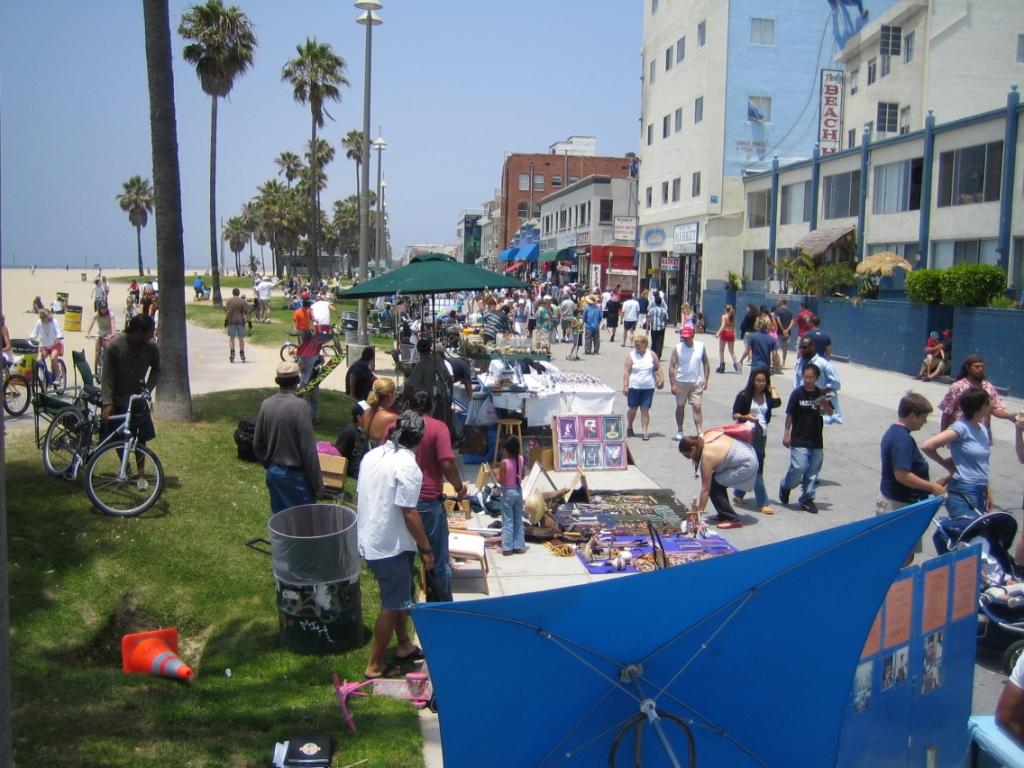
While Americans celebrated the American Revolution, as a Canadian, I was having the best time of my life living in Venice Beach, California in the Spirit of ´76. It was my first winter in the warm sun in my lifetime. The Times and Winds of Change were favorable toward me since this unexpected Day.

At that time, Venice Beach was the self-proclaimed, last bastion of Freedom in the un-United States. The idea was anyone was Free to do anything, as long as there was no harm done to others, or diminished their equal rights.

One Day, I decided to test how real this right of Freedom of Speech was practiced in Venice? Sitting on a bench on the Boardwalk with my back to the ocean, I started to read from the Bible in a very loud voice. It seemed as though the Wind from the sea carried the words so that they reverberated among the buildings and along the Beach.

Watching the passersby, there were so many comments to the effect, ¨You can´t do that here. Go some place else.¨ People actually covered their ears, saying ¨Stop that! Stop that!” It was appearing more and more, many people don´t practice what they preach or believe in Freedom of Speech except for their own.

Continuing to read, someone came up to me sitting on the bench and cracked an egg on my head!

I was temporarily stunned, as the yoke dripped down my hair and face, onto my shirt and the Bible in my hands.

How to react? Should I stand up in the anger and wrath of God? Should I condemn him to Hell? It took a few seconds, but recovering, I stood up and said,

¨Have you never read these words in this Book? Learn of me, for I am meek and lowly. Take my yoke upon you, for my yoke is easy and my burden IS Light.”

Matthew 11:28-30                                                                                  

 After that, others came apologizing for that one and cleaned me up.

AN EMPIRE OF LIES


Why Our Media Betray Us

By JONATHAN COOK

February 28, 2011

Counterpunch

Last week the Guardian, Britain’s main liberal newspaper, ran an exclusive report on the belated confessions of an Iraqi exile, Rafeed al-Janabi, codenamed “Curveball” by the CIA. Eight years ago, Janabi played a key behind-the-scenes role — if an inadvertent one — in making possible the US invasion of Iraq. His testimony bolstered claims by the Bush administration that Iraq’s president, Saddam Hussein, had developed an advanced programme producing weapons of mass destruction.

Curveball’s account included the details of mobile biological weapons trucks presented by Colin Powell, the US Secretary of State, to the United Nations in early 2003. Powell’s apparently compelling case on WMD was used to justify the US attack on Iraq a few weeks later.

Eight years on, Curveball revealed to the Guardian that he had fabricated the story of Saddam’s WMD back in 2000, shortly after his arrival in Germany seeking asylum. He told the paper he had lied to German intelligence in the hope his testimony might help topple Saddam, though it seems more likely he simply wanted to ensure his asylum case was taken more seriously.

For the careful reader — and I stress the word careful — several disturbing facts emerged from the report.

One was that the German authorities had quickly proven his account of Iraq’s WMD to be false. Both German and British intelligence had travelled to Dubai to meet Bassil Latif, his former boss at Iraq’s Military Industries Commission. Dr Latif had proven that Curveball’s claims could not be true. The German authorities quickly lost interest in Janabi and he was not interviewed again until late 2002, when it became more pressing for the US to make a convincing case for an attack on Iraq.

Another interesting disclosure was that, despite the vital need to get straight all the facts about Curveball’s testimony — given the stakes involved in launching a pre-emptive strike against another sovereign state — the Americans never bothered to interview Curveball themselves.

A third revelation was that the CIA’s head of operations in Europe, Tyler Drumheller, passed on warnings from German intelligence that they considered Curveball’s testimony to be highly dubious. The head of the CIA, George Tenet, simply ignored the advice.

With Curveball’s admission in mind, as well as these other facts from the story, we can draw some obvious conclusions — conclusions confirmed by subsequent developments.

Lacking both grounds in international law and the backing of major allies, the Bush administration desperately needed Janabi’s story about WMD, however discredited it was, to justify its military plans for Iraq. The White House did not interview Curveball because they knew his account of Saddam’s WMD programme was made up. His story would unravel under scrutiny; better to leave Washington with the option of “plausible deniability”.

Nonetheless, Janabi’s falsified account was vitally useful: for much of the American public, it added a veneer of credibility to the implausible case that Saddam was a danger to the world; it helped fortify wavering allies facing their own doubting publics; and it brought on board Colin Powell, a former general seen as the main voice of reason in the administration.

In other words, Bush’s White House used Curveball to breathe life into its mythological story about Saddam’s threat to world peace.

So how did the Guardian, a bastion of liberal journalism, present its exclusive on the most controversial episode in recent American foreign policy?

Here is its headline: “How US was duped by Iraqi fantasist looking to topple Saddam”.

Did the headline-writer misunderstand the story as written by the paper’s reporters? No, the headline neatly encapsulated its message. In the text, we are told Powell’s presentation to the UN “revealed that the Bush administration’s hawkish decisionmakers had swallowed” Curveball’s account. At another point, we are told Janabi “pulled off one of the greatest confidence tricks in the history of modern intelligence”. And that: “His critics — who are many and powerful — say the cost of his deception is too difficult to estimate.”

In other words, the Guardian assumed, despite all the evidence uncovered in its own research, that Curveball misled the Bush administration into making a disastrous miscalculation. On this view, the White House was the real victim of Curveball’s lies, not the Iraqi people — more than a million of whom are dead as a result of the invasion, according to the best available figures, and four million of whom have been forced into exile.

There is nothing exceptional about this example. I chose it because it relates to an event of continuing and momentous significance.

Unfortunately, there is something depressingly familiar about this kind of reporting, even in the West’s main liberal publications. Contrary to its avowed aim, mainstream journalism invariably diminishes the impact of new events when they threaten powerful elites.

We will examine why in a minute. But first let us consider what, or who, constitutes “empire” today? Certainly, in its most symbolic form, it can be identified as the US government and its army, comprising the world’s sole superpower.

Traditionally, empires have been defined narrowly, in terms of a strong nation-state that successfully expands its sphere of influence and power to other territories. Empire’s aim is to make those territories dependent, and then either exploit their resources in the case of poorly developed countries, or, with more developed countries, turn them into new markets for its surplus goods. It is in this latter sense that the American empire has often been able to claim that it is a force for global good, helping to spread freedom and the benefits of consumer culture.

Empire achieves its aims in different ways: through force, such as conquest, when dealing with populations resistant to the theft of their resources; and more subtly through political and economic interference, persuasion and mind-control when it wants to create new markets. However it works, the aim is to create a sense in the dependent territories that their interests and fates are bound to those of empire.

In our globalised world, the question of who is at the centre of empire is much less clear than it once was. The US government is today less the heart of empire than its enabler. What were until recently the arms of empire, especially the financial and military industries, have become a transnational imperial elite whose interests are not bound by borders and whose powers largely evade legislative and moral controls.

Israel’s leadership, we should note, as well its elite supporters around the world — including the Zionist lobbies, the arms manufacturers and Western militaries, and to a degree even the crumbling Arab tyrannies of the Middle East — are an integral element in that transnational elite.

The imperial elites’ success depends to a large extent on a shared belief among the western public both that “we” need them to secure our livelihoods and security and that at the same time we are really their masters. Some of the necessary illusions perpetuated by the transnational elites include:

— That we elect governments whose job is to restrain the corporations;

— That we, in particular, and the global workforce in general are the chief beneficiaries of the corporations’ wealth creation;

— That the corporations and the ideology that underpins them, global capitalism, are the only hope for freedom;

— That consumption is not only an expression of our freedom but also a major source of our happiness;

— That economic growth can be maintained indefinitely and at no long-term cost to the health of the planet;

— And that there are groups, called terrorists, who want to destroy this benevolent system of wealth creation and personal improvement.

These assumptions, however fanciful they may appear when subjected to scrutiny, are the ideological bedrock on which the narratives of our societies in the West are constructed and from which ultimately our sense of identity derives. This ideological system appears to us — and I am using “we” and “us” to refer to western publics only — to describe the natural order.

The job of sanctifying these assumptions — and ensuring they are not scrutinised — falls to our mainstream media. Western corporations own the media, and their advertising makes the industry profitable. In this sense, the media cannot fulfil the function of watchdog of power, because in fact it is power. It is the power of the globalised elite to control and limit the ideological and imaginative horizons of the media’s readers and viewers. It does so to ensure that imperial interests, which are synonymous with those of the corporations, are not threatened.

The Curveball story neatly illustrates the media’s role.

His confession has come too late — eight years too late, to be precise — to have any impact on the events that matter. As happens so often with important stories that challenge elite interests, the facts vitally needed to allow western publics to reach informed conclusions were not available when they were needed. In this case, Bush, Cheney and Rumsfeld are gone, as are their neoconservative advisers. Curveball’s story is now chiefly of interest to historians.

That last point is quite literally true. The Guardian’s revelations were of almost no concern to the US media, the supposed watchdog at the heart of the US empire. A search of the Lexis Nexis media database shows that Curveball’s admissions featured only in the New York Times, in a brief report on page 7, as well as in a news round-up in the Washington Times. The dozens of other major US newspapers, including the Washington Post, made no mention of it at all.

Instead, the main audience for the story outside the UK was the readers of India’s Hindu newspaper and the Khaleej Times.

But even the Guardian, often regarded as fearless in taking on powerful interests, packaged its report in such a way as to deprive Curveball’s confession of its true value. The facts were bled of their real significance. The presentation ensured that only the most aware readers would have understood that the US had not been duped by Curveball, but rather that the White House had exploited a “fantasist” — or desperate exile from a brutal regime, depending on how one looks at it — for its own illegal and immoral ends.

Why did the Guardian miss the main point in its own exclusive? The reason is that all our mainstream media, however liberal, take as their starting point the idea both that the West’s political culture is inherently benevolent and that it is morally superior to all existing, or conceivable, alternative systems.

In reporting and commentary, this is demonstrated most clearly in the idea that “our” leaders always act in good faith, whereas “their” leaders — those opposed to empire or its interests — are driven by base or evil motives.

It is in this way that official enemies, such as Saddam Hussein or Slobodan Milosevic, can be singled out as personifying the crazed or evil dictator — while other equally rogue regimes such as Saudi Arabia’s are described as “moderate” — opening the way for their countries to become targets of our own imperial strategies.

States selected for the “embrace” of empire are left with a stark choice: accept our terms of surrender and become an ally; or defy empire and face our wrath.

When the corporate elites trample on other peoples and states to advance their own selfish interests, such as in the invasion of Iraq to control its resources, our dominant media cannot allow its reporting to frame the events honestly. The continuing assumption in liberal commentary about the US attack on Iraq, for example, is that, once no WMD were found, the Bush administration remained to pursue a misguided effort to root out the terrorists, restore law and order, and spread democracy.

For the western media, our leaders make mistakes, they are naïve or even stupid, but they are never bad or evil. Our media do not call for Bush or Blair to be tried at the Hague as war criminals.

This, of course, does not mean that the western media is Pravda, the propaganda mouthpiece of the old Soviet empire. There are differences. Dissent is possible, though it must remain within the relatively narrow confines of “reasonable” debate, a spectrum of possible thought that accepts unreservedly the presumption that we are better, more moral, than them.

Similarly, journalists are rarely told — at least, not directly — what to write. The media have developed careful selection processes and hierarchies among their editorial staff — termed “filters” by media critics Ed Herman and Noam Chomsky — to ensure that dissenting or truly independent journalists do not reach positions of real influence.

There is, in other words, no simple party line. There are competing elites and corporations, and their voices are reflected in the narrow range of what we term commentary and opinion. Rather than being dictated to by party officials, as happened under the Soviet system, our journalists scramble for access, to be admitted into the ante-chambers of power. These privileges make careers but they come at a huge cost to the reporters’ independence.

Nonetheless, the range of what is permissible is slowly expanding — over the opposition of the elites and our mainstream TV and press. The reason is to be found in the new media, which is gradually eroding the monopoly long enjoyed by the corporate media to control the spread of information and popular ideas. Wikileaks is so far the most obvious, and impressive, outcome of that trend.

The consequences are already tangible across the Middle East, which has suffered disproportionately under the oppressive rule of empire. The upheavals as Arab publics struggle to shake off their tyrants are also stripping bare some of the illusions the western media have peddled to us. Empire, we have been told, wants democracy and freedom around the globe. And yet it is caught mute and impassive as the henchmen of empire unleash US-made weapons against their peoples who are demanding western-style freedoms.

An important question is: how will our media respond to this exposure, not just of our politicians’ hypocrisy but also of their own? They are already trying to co-opt the new media, including Wikileaks, but without real success. They are also starting to allow a wider range of debate, though still heavily constrained, than had been possible before.

The West’s version of glasnost is particularly obvious in the coverage of the problem closest to our hearts here in Palestine. What Israel terms a delegitimisation campaign is really the opening up — slightly — of the media landscape, to allow a little light where until recently darkness reigned.

This is an opportunity and one that we must nurture. We must demand of the corporate media more honesty; we must shame them by being better-informed than the hacks who recycle official press releases and clamour for access; and we must desert them, as is already happening, for better sources of information.

We have a window. And we must force it open before the elites of empire try to slam it shut.

http://www.jkcook.net/Articles3/0549.htm

An elaborate con on the common man
Propelled by your massive media plan.
And I can see your hostile takeover, greed and your lies.
Turning what I love into what I despise.

It’s a tale of mass deception, destruction, corruption
And I’m under the assumption the government will function
By a clear and present danger, I’m fearing a stranger
Corporation of fear and mind control
They gotta go

You’re telling lies to cover all those tracks
But it’s misinformation, any honesty it lacks
Your faces now testify how it all went wrong
A nation taken for a ride and strung along

Suffering the wrath, or the immanent collapse
The result for the ignorance of assorted past
Will I watch it all crash? Your departure at long last?
Only the yearn for some honesty here.

So you got the dictator but why go lie
About the poision, the atomic fry
Went on PR tour with honchos in tow
Told the world a big lie about all that you know

Tale of mass deception, tale of mass deception