
As a Senior Citizen living on CanaDa’s Old Age Security of $1850 a month to pay rent, utilities, food, car expenses and everything else, it’s awesome to see that digital amount just appear in my Bank Account every month. I can manage only because I’m blessed with a large well laid out 1 bedroom apartment, heated, with a parking space right in Downtown Ottawa-Hull costing $566 a month.
That’s because I lived here since 2006 long before rents started going crazy. The landlord, I didn’t know from Adam when I moved in, surprised me with the unexpected promise he wouldn’t raise my rent as long as I lived here, and he kept the promise. That’s a Dream apartment considering something similar costs $1200-$1400 a month these Days.
We are already getting accustomed to paying all expenses with a Credit or Debit card and it seems so convenient, but there are dangers to our Future Freedoms as outlined by William Engdahl, an Economic expert I’ve been following for years.
Below is his Newsletter I just received by email this morning I think vigilant people must be made aware of.
An operation that began as a seemingly obscure academic discussion three years ago is now becoming a full-blown propaganda campaign by some of the most powerful institutions in the industrialized world. This is what rightly should be termed the War on Cash. Like the War on Terror, the War on Cancer or the War on Drugs, its true agenda is sinister and opaque. If we are foolish enough to swallow the propaganda for complete elimination of cash in favor of pure digital bank money, we can pretty much kiss our remaining autonomy and privacy goodbye. George Orwell’s 1984 will be here on steroids.
Let me be clear. Here we discuss not various block-chain digital technologies, so-called crypto-currencies. We are not addressing private payment systems such as China’s WeChat. Nor do we discuss e-banking or use of bank credit cards such as Visa or Master Card or others. These are of an entirely different quality from the goal of the ongoing sinister war on cash. They are all private services not state.
What we are discussing is a plot, and it is a plot, by leading central banks, select governments, the International Monetary Fund in collusion with major international banks to force citizens—in other words, us!—to give up holding cash or using it to pay for purchases. Instead we would be forced to use digital bank credits. The difference, subtle though it may at first seem, is huge. As in India following the mad Modi US-inspired war on cash late in 2016, citizens would forever lose their personal freedom to decide how to pay or their privacy in terms of money. If I want to buy a car and pay cash to avoid bank interest charges, I cannot. My bank will limit the amount of digital money I can withdraw on any given day. If I want to stay in a nice hotel to celebrate a special day and pay cash for reasons of privacy, not possible. But this is just the surface.
Visa joins the war
This July, Visa International rolled out what it calls “The Visa Cashless Challenge.” With select buzz words about how technology has transformed global commerce, Visa announced a program to pay selected small restaurant owners in the USA if they agree to refuse to accept cash from their customers but only credit cards. The official Visa website announces, “Up to $500,000 in awards. 50 eligible food service owners. 100% cashless quest.” [i] Now for a mammoth company such as Visa with annual revenues in the $15 billion range, a paltry $500,000 is chump change. Obviously, they believe it will advance use of Visa cards in a market that until now prefers cash—the small family restaurant.
The Visa “challenge” to achieve what it calls the “100% cashless quest” is no casual will-o’-the-wisp. It is part of a very thought-through strategy of not only Visa, but also the European Central Bank, the Bank of England, the International Monetary Fund and the Reserve Bank of India to name just a few.

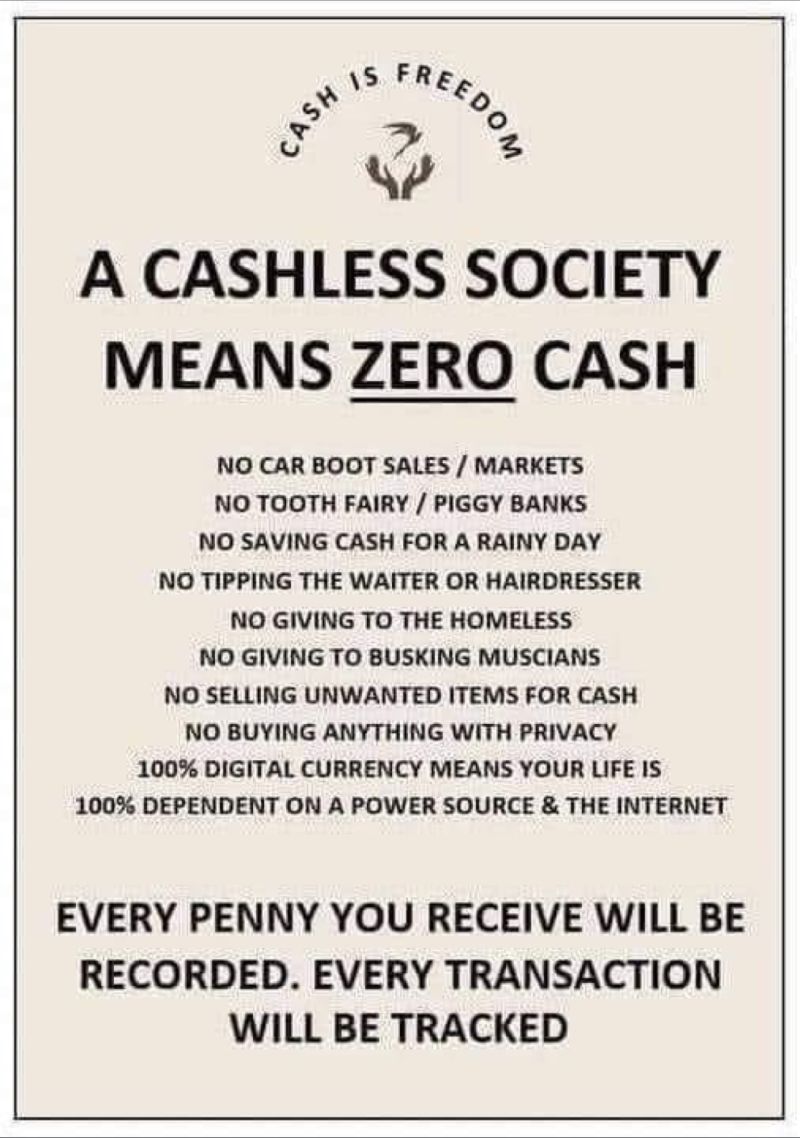
The Rich will not be able to do this in a cashless society and there will be no more under the table earnings
IMF on Boiling Frogs
In March this year the International Monetary Fund in Washington issued a Working Paper on what they call “de-cashing.” The paper recommends that, “going completely cashless should be phased in steps.” It notes the fact that there already exist “initial and largely uncontested steps, such as the phasing out of large denomination bills, the placement of ceilings on cash transactions, and the reporting of cash moves across the borders. Further steps could include creating economic incentives to reduce the use of cash in transactions, simplifying the opening and use of transferrable deposits, and further computerizing the financial system.” [ii]
In France since 2015 the limit a person may pay in cash to a business is a mere €1000 “to tackle money laundering and tax evasion.” Moreover, any deposit or withdrawal of cash from a bank account in excess of €10,000 in a month will automatically be reported to Tracfin, a unit of the French government charged with combating money laundering, “largely uncontested steps” and very ominous portents. [iii]
The IMF paper further adds as argument for eliminating cash that “de-cashing should improve tax collection by reducing tax evasion.” Said with other words, if you are forced to use only digital money transfers from a bank, the governments of virtually every OECD country today have legal access to the bank data of their citizens.
In April, a month after the IMF paper on de-cashing, the Brussels EU Commission released a statement that declared, “Payments in cash are widely used in the financing of terrorist activities. In this context, the relevance of potential upper limits to cash payments could also be explored. Several Member States have in place prohibitions for cash payments above a specific threshold.” [iv]
Even in Switzerland, as a result of relentless campaigns by Washington, their legendary bank secrecy has been severely compromised under the fallacious argument it hinders financing of terrorist organizations. A glance at recent European press headlines about attacks from Barcelona to Munich to London to Charlottesville exposes this argument as a sham.
Today in the EU, as further result of Washington pressure, under the Foreign Account Tax Compliance Act (FATCA) banks outside the USA where US citizens hold a deposit are forced to file yearly reports on the assets in those accounts to the Financial Crimes Enforcement Network of the US Treasury. Conveniently for the US as the major emerging tax haven, the US Government has refused, despite it being specified in the Act, to join FACTA itself. [v]
In 2016 the European Central Bank discontinued issuing €500 bills arguing it would hinder organized crime and terrorism, a poor joke to be sure, as if the sophisticated networks of organized crime depend on paper currencies. In the US, leading economists such as former Harvard President Larry Summers advocate eliminating the $100 bill for the same alleged reason.

$10 limit?
The real aim of the war on cash however was outlined in a Wall Street Journal OpEd by Harvard economist and former chief economist at the IMF, Kenneth Rogoff. Rogoff argues that there should be a drastic reduction in the Federal Reserve’s issuance of cash. He calls for all bills above the $10 bill to be removed from circulation, thereby forcing people and businesses to depend on digital or electronic payments solely. He repeats the bogus mantra that his plan would reduce money-laundering, thereby reduce crime while at the same time exposing tax cheats. [vi]
However, the hidden agenda in this War on Cash is confiscation of our money in the next, inevitable banking crisis, whether in the EU member countries, the United States or developing countries like India.
Already several central banks have employed a policy of negative interest rates alleging, falsely, that this is necessary to stimulate growth following the 2008 financial and banking crisis. In addition to the European Central Bank, the Bank of Japan, the Danish National Bank adhere to this bizarre policy. However, their ability to lower interest rates to member banks even more is constrained as long as cash is plentiful.
Here the above cited IMF document lets the proverbial cat out of the sack. It states, “In particular, the negative interest rate policy becomes a feasible option for monetary policy if savings in physical currency are discouraged and substantially reduced. With de-cashing, most money would be stored in the banking system, and, therefore, would be easily affected by negative rates, which could encourage consumer spending…” [vii] That’s because your bank will begin to charge you for the “service” of allowing you to park your money with them where they can use it to make more money. To avoid that, we are told, we would spend like there’s no tomorrow. Obviously, this argument is fake.
As German economist Richard Werner points out, negative rates raise banks’ costs of doing business. “The banks respond by passing on this cost to their customers. Due to the already zero deposit rates, this means banks will raise their lending rates.” As Werner further notes, “In countries where a negative interest rate policy has been introduced, such as Denmark or Switzerland, the empirical finding is that it is not effective in stimulating the economy. Quite the opposite. This is because negative rates are imposed by the central bank on the banks – not the borrowing public. [viii]
He points out that the negative interest rate policy of the ECB is aimed at destroying the functioning, traditionally conservative EU savings banks such as the German Sparkassen and Volksbanken in favor of covertly bailing out the giant and financially corrupt mega-banks such as Deutsche Bank, HSBC, Societe Generale of France, Royal Bank of Scotland, Alpha Bank of Greece, or Banca Monte dei Paschi di Siena in Italy and many others. [ix] The President of the ECB, Mario Draghi is a former partner of the mega bank, Goldman Sachs.
Why Now?
The relevant question is why now, suddenly the urgency of pushing for elimination of cash on the part of central banks and institutions such as the IMF? The drum roll for abolishing cash began markedly following the January 2016 Davos, Switzerland World Economic Forum where the western world’s leading government figures and central bankers and multinational corporations were gathered. The propaganda offensive for the current War on Cash offensive began immediately after the Davos talks.
Several months later, in November, 2016, guided by experts from USAID and, yes, Visa, the Indian government of Narenda Modi announced the immediate demonetization or forced removal of all 500 Rupee (US$8) and 1,000 Rupee (US$16) banknotes on the recommendation of the Reserve Bank of India. The Modi government claimed that the action would curtail the shadow economy and crack down on the use of illicit and counterfeit cash to fund illegal activity and terrorism.
Notably, the Indian Parliament recently made a follow-up study of the effects of the Modi war on cash. The Parliamentary Committee on Demonetization report documented that not a single stated objective was met. No major black money was found and Demonetization had no effect on terror funding, the reasons given by the Government to implement such a drastic policy. The report noted that while India’s central bank was allegedly attacking black money via demonetization, the serious illegal money in offshore tax havens was simply recycled back into India, “laundered” via Foreign Direct Investment by the criminal or corporate groups legally in a practice known as “Round Tripping.”
Yet the Parliament’s report detailed that the real Indian economy was dramatically hit. Industrial Production in April declined by a shocking 10.3 percent over the previous month as thousands of small businesses dependent on cash went under. Major Indian media have reportedly been warned by the Modi government not to publicize the Parliament report. [x]
If we connect the dots on all this, it becomes clearer that the war on cash is a war on our individual freedom and degrees of freedom in our lives. Forcing our cash to become digital is the next step towards confiscation by the governments of the EU or USA or wherever the next major banking crisis such as in 2007-2008 erupts.
In late July this year Estonia as rotating presidency of the EU issued a proposal backed by Germany that would allow EU national regulators to “temporarily” stop people from withdrawing their funds from a troubled bank before depositors were able to create a bank “run.” [xi] The EU precedent was already set in Cyprus and in Greece where the government blocked cash withdrawals beyond tiny daily amounts.
As veteran US bank analyst Christopher Whelan points out in a recent analysis of the failure of the EU authorities to effectively clean up their banking mess since the 2008 financial crisis, “the idea that the banking public – who generally fall well-below the maximum deposit insurance limit – would ever be denied access to cash virtually ensures that deposit runs and wider contagion will occur in Europe next time a depository institution gets into trouble.” Whelan points out that nine years after the 2008 crisis, EU banks remain in horrendous condition. “There remains nearly €1 trillion in bad loans within the European banking system. This represents 6.7% of the EU economy. That’s huge. He points out that banks’ bad loans as share of GDP for US and Japan banks are 1.7 and 1.6 percent respectively. [xii]
As governments, whether in the EU or in India or elsewhere refuse to rein in fraudulent practices of its largest banks, forcing people to eliminate use of cash and keep all their liquidity in digital deposits with state regulated banks, sets the stage for the state to confiscate those assets when they declare the next emergency. If we are foolish enough to permit this scam to pass unchallenged perhaps we deserve to lose our vestige of financial autonomy. Fortunately, popular resistance against elimination of cash in countries like Germany is massive. Germans recall the days of the 1920s Weimar Republic and hyperinflation as the 1931 banking crises that led to the Third Reich. The IMF approach is that of the Chinese proverb on boiling frogs slowly. But human beings are not frogs, or?

https://www.williamengdahl.com


