All US Politicians are obligated in most Christian America to end their speeches with ‘God Bless America!’ President Biden limits that to ‘God Bless OUR Troops!’
The US is the biggest ARMS MERCHANT in the History of Nations, and US Christian Leaders remain BLIND and OBLIVIOUS to this Vision in their Bibles, “‘Not by Military Force, and not by physical strength, but by my Spirit’ says the Lord of Hosts. Mirroring the US government, there are more weapons in private hands than for any other People on Earth reserved unto that Day of Judgment when they will be used by Americans against Americans
Red-white-and-blue chauvinism is running wild. Yet there are real diplomatic alternatives to the collision course for war
Fifty-nine years ago, Bob Dylan recorded “With God on Our Side.” You probably haven’t heard it on the radio for a very long time, if ever, but right now you could listen to it as his most evergreen of topical songs:
Oh, my name, it ain’t nothin’, my age, it means less The country I come from is called the Midwest I’s taught and brought up there, the laws to abide And that the land that I live in has God on its side
Oh, the history books tell it, they tell it so well The cavalries charged, the Indians fell The cavalries charged, the Indians died Oh, the country was young with God on its side
The Spanish-American War had its day And the Civil War too was soon laid away And the names of the heroes I was made to memorize With guns in their hands and God on their side
The First World War, boys, it came and it went The reason for fightin’ I never did get But I learned to accept it, accept it with pride For you don’t count the dead when God’s on your side
The Second World War came to an end We forgave the Germans, and then we were friends Though they murdered six million, in the ovens they fried The Germans now too have God on their side
I learned to hate the Russians all through my whole life If another war comes, it’s them we must fight To hate them and fear them, to run and to hide And accept it all bravely with God on my side
But now we’ve got weapons of chemical dust If fire them we’re forced to, then fire them we must One push of the button and they shot the world wide And you never ask questions when God’s on your side
Through many dark hour I been thinkin’ about this That Jesus Christ was betrayed by a kiss But I can’t think for you, you’ll have to decide Whether Judas Iscariot had God on his side
So now as I’m leavin’, I’m weary as hell The confusion I’m feelin’ ain’t no tongue can tell The words fill my head, and they fall to the floor That if God’s on our side, he’ll stop the next war
In recent days, media coverage of a possible summit between Joe Biden and Vladimir Putin has taken on almost wistful qualities, as though the horsemen of the apocalypse are already out of the barn.
Fatalism is easy for the laptop warriors and blow-dried studio pundits who keep insisting on the need to get tough with “the Russians,” by which they mean the Russian government. Actual people who suffer and die in war easily become faraway abstractions. “And you never ask questions / When God’s on your side.”
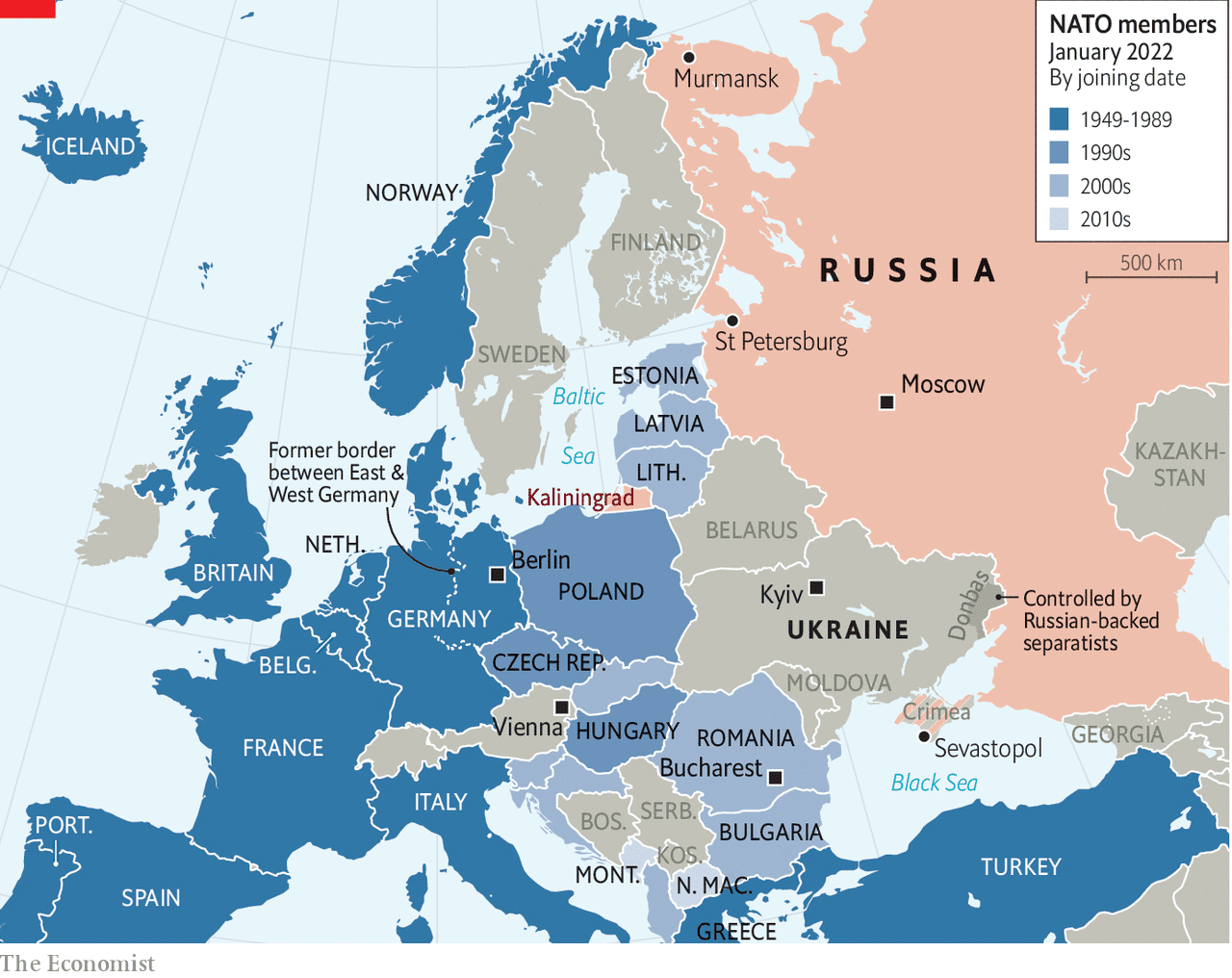
During the last six decades, the religiosity of U.S. militarism has faded into a more generalized set of assumptions—shared, in the current crisis, across traditional political spectrums. Ignorance about NATO’s history feeds into the good vs. evil bromides that are so easy to ingest and internalize.
On Capitol Hill, it’s hard to find a single member of Congress willing to call NATO what it has long been: an alliance for war (Kosovo, Afghanistan, Libya) with virtually nothing to do with “defense” other than the defense of vast weapons sales and, at times, even fantasies of regime change in Russia.
The reverence and adulation gushing from the Capitol and corporate media (including NPR and PBS) toward NATO and its U.S. leadership are wonders of thinly veiled jingoism. About other societies, reviled ones, we would hear labels like “propaganda.” Here the supposed truisms are laundered and flat-ironed as common sense.
Glimmers of inconvenient truth have flickered only rarely in mainstream U.S. media outlets, while a bit more likely in Europe. “Biden has said repeatedly that the U.S. is open to diplomacy with Russia, but on the issue that Moscow has most emphasized—NATO enlargement—there has been no American diplomacy at all,” Jeffrey Sachs wrote in the Financial Times as this week began. “Putin has repeatedly demanded that the U.S. forswear NATO’s enlargement into Ukraine, while Biden has repeatedly asserted that membership of the alliance is Ukraine’s choice.”
As Sachs noted, “Many insist that NATO enlargement is not the real issue for Putin and that he wants to recreate the Russian empire, pure and simple. Everything else, including NATO enlargement, they claim, is a mere distraction. This is utterly mistaken. Russia has adamantly opposed NATO expansion towards the east for 30 years, first under Boris Yeltsin and now Putin…. Neither the U.S. nor Russia wants the other’s military on their doorstep. Pledging no NATO enlargement is not appeasement. It does not cede Ukrainian territory. It does not undermine Ukraine’s sovereignty.”
Whether or not they know much about such history, American media elites and members of Congress don’t seem to care about it. Red-white-and-blue chauvinism is running wild. Yet there are real diplomatic alternatives to the collision course for war.
Speaking Monday on Democracy Now!, Katrina vanden Heuvel—editorial director of The Nation and a longtime Russia expert—said that implementing the Minsk accords could be a path toward peace in Ukraine. Also, she pointed out, “there is talk now not just of the NATO issue, which is so key, but also a new security architecture in Europe.”
Desperately needed is a new European security framework, to demilitarize and defuse conflicts between Russia and U.S. allies. But the same approach that for three decades pushed to expand NATO to Russia’s borders is now gung-ho to keep upping the ante, no matter how much doing so increases the chances of a direct clash between the world’s two nuclear-weapons superpowers.
The last U.S. ambassador to the Soviet Union before it collapsed, Jack Matlock, wrote last week: “Since President Putin’s major demand is an assurance that NATO will take no further members, and specifically not Ukraine or Georgia, obviously there would have been no basis for the present crisis if there had been no expansion of the alliance following the end of the Cold War, or if the expansion had occurred in harmony with building a security structure in Europe that included Russia.”
But excluding Russia from security structures, while encircling it with armed-to-the-teeth adversaries, was a clear goal of NATO’s expansion. Less obvious was the realized goal of turning Eastern European nations into customers for vast arms sales.
A gripping chapter in “The Spoils of War,” a new book by Andrew Cockburn, spells out the mega-corporate zeal behind the massive campaigns to expand NATO beginning in the 1990s. Huge Pentagon contractors like Lockheed Martin were downcast about the dissolution of the USSR and feared that military sales would keep slumping. But there were some potential big new markets on the horizon.
“One especially promising market was among the former members of the defunct Warsaw Pact,” Cockburn wrote. “Were they to join NATO, they would be natural customers for products such as the F-16 fighter that Lockheed had inherited from General Dynamics. There was one minor impediment: the [George H. W.] Bush administration had already promised Moscow that NATO would not move east, a pledge that was part of the settlement ending the Cold War.”
By the time legendary foreign-policy sage George F. Kennan issued his unequivocal warning in 1997—“expanding NATO would be the most fateful error of American policy in the post-Cold War era”—the expansion was already happening.
As Cockburn notes, “By 2014, the 12 new members had purchased close to $17 billion worth of American weapons.”
If you think those weapons transactions were about keeping up with the Russians, you’ve been trusting way too much U.S. corporate media. “As of late 2020,” Cockburn’s book explains, NATO’s collective military spending “had hit $1.03 trillion, or roughly 20 times Russia’s military budget.”
Let’s leave the last words here to Bob Dylan, from another song that isn’t on radio playlists. “Masters of War.”
Let me ask you one question Is your money that good? Will it buy you forgiveness Do you think that it could?
Time is flying! I was surprised and held in Wonder, AWE, and Rapture unexpectedly being BORN AGAIN on February 1, 1975 when I was 31, a babe in starting to learn the ways of the Christ Spirit. I start my 82nd Year Wednesday, May 21 and my Personal Faith is stronger than ever.
As a World Citizen, Child of God at 77, and a Canadian, I sent the same Message to all 100 Senators November 5,8,15 &16, not as Representatives of Local Parochial interests, but as National and International Leaders, but giving NOTICE of the US-Russian WAR over Ukraine in NATO that started 2 months later.
It took that long finding an address and ZIP code in all 50 States since the Senate email system has no provision to hear opinions other than from the Constituents of their States.
Identifying myself as a Canadian in the 1st sentence & using my actual name and email address in the Senate forms, a Senate majority sent me their computer generated Newsletters without addressing anything in the November Message concerned with US Domestic Developments as if whoever opens the email didn’t read it.
Senators have equal influence collectively as the Executive Branch. I could only hope and pray saner heads would prevail, although from what I see on CNN, MSNBC & FOX, that seems unlikely to reduce International tensions, but increase them.
Putin doesn’t want War. No sane person would want MUTUALLY ASSURED DESTRUCTION unless there is a subconscious desire for SUICIDE BY NUKES.
All Putin wants is NATO to stop advancing to Russia’s border just like Americans didn’t want Soviet missiles that close to the US in Cuba. In 1962, the US actually starsted Armageddon/WWIII over Russian missiles in Cuba with the US Navy blockade of Cuba, a VIOLATION of International Law. Russia was reacting to the US putting their missiles aimed at Russia in new NATO Member Turkey.
President Kennedy didn’t want WAR either seeing how close it came to be from the inside during the 1962 Cuban Missile Crisis. He wanted to start a genuine reconciliation and accommodation that would lead to a real PEACE with Russia.
This is how he described the alternative to undertaking the sincere, in good Faith;
Kennedy uttered the essential TRUTH that can keep us alive today in 1963: “Above all, while defending our own vital interests, nuclear powers must avert those confrontations which bring an adversary to a choice of either a humiliating retreat or a nuclear war. To adopt that kind of course in the nuclear age would be evidence only of the bankruptcy of our policy–or of a collective death-wish for the world.”
He was killed a few months later, I believe, because his Intention to make Peace with Russia infuriated and displeased the America 1st the US Establishment Neo-Con WAR mongers. The excerpt above he gave April 10, 1963, known as the PEACE SPEECH is what got him killed.
Americans aren’t exceptional.
Like the US did in 1962, Putin correctly sees the steady incremental advance of NATO to the border of Russia since the 1991 collapse of the Soviet Union and the Military Warsaw Pact opposite NATO, is not defensive, but offensive. I see that leading indicator Independently watching from CanaDa.
US/NATO claiming Russia wants to re-constitute the Soviet Union is US hype to sell more Weapons of Death & Destruction preparing Americans for the FINAL WAR to End ALL WARS, WWIII/Armageddon.
Vladimir Putin, “Anyone who doesn’t regret the passing of the Soviet Union has no heart. Anyone who wants it restored has no brains.”
New York Times 20 February 2000;
Putin is following that 1962 US playbook. If it was Good when the US did it, is it EVIL because Putin is drawing his red line exactly like the US already did in 1962?
US paid Propagandists use words like, “since Russia’s aggression in Ukraine.” That’s how subtle Propaganda is.
Trucks on Russia’s side of the border, covered in snow and parked for weeks, is aggression? What is aggressive, is the US pouring $Billions of weapons into Ukraine, with NATO troops already in Ukraine, with more possibly on the way, inflaming the situation on the ground.
US proxy NATO announced they will not commit troops to Ukraine, but are transferring $BILLIONS in weapons for Ukrainians even though all Western ‘Military Experts’ say Ukraine doesn’t have a chance of defeating Russia. What that exposes is the US/NATO is using Ukrainians as Sacrificial lambs in the War the US started with Russia since the end of WWII, now at the final stage on the Path of Destruction.
This confirms in Putin’s eyes it’s the US as the hegemon beating the War Drums, leading to Armageddon/WWIII the US put on the table in 1962.
According to CNN & MSNBC News reports, the Ukrainians themselves are not worried about a Russian invasion. This is a US freak out to distract from the increasing Domestic problems and Divisions I wrote about in November.
This is more interesting for me to watch unfolding from CanaDa because of this 1 line among so many more in my Curriculum Vitae, as recorded by The Kansas City Times September 13, 1976,
“He wanted to bring to the Public’s attention “an idea being put out subtly and deceptively” by the government that we have to get prepared for a War with Russia.”
That 1976 FUTURE is NOW with the Revelation of the details GENERALLY unfolding in the spirit of the letter.
With the benefit of 45 years hindsight, the last 8 years of intensified Military, FBI and Intelligence “experts” on TV constantly, unanimously, demonizing Putin and Russia since the 2014 US orchestrated Coup/regime change of the Russian friendly government, installing an Neo-Nazi anti-Russian government, the American People have been prepared as the majority of comments in all Washington Post articles on the US-Russian Tug of War over Ukraine prove beyond any doubt.
As a further Sign of The Times The Kansas City Times did a followup on ALL SOULS DAY, November 2, 1976, publishing this Historical Newspaper record:
You may imagine my Surprise and Wonder when the TV movie ‘THE DAY AFTER’ Kansas City was incinerated in a Nuclear Holocaust was shown 7 years to the month later, on November 20, 1983?
Most probably, I was the only person on Earth watching it that night to NOTE at THE END, the movie pauses at the same picture frame The Kansas City Times published on ALL SOULS DAY, November 2, 1976, this being the TV screenshot:
The fact TV movie THE DAY AFTER appeared 7 Years to the month later, on November 20, 1983 pausing at the exact same spot as the Kansas City Times picture above, is a SIGN OF THE TIMES this World has arrived at these 49 Years later.
Those Historical records are Signs of the Times of where this World is at Today. They can dismissed as being of no consequence, but the Historical Record cannot be changed.
Only Time will tell. Reading about and watching the hyped up US News Today, that Time may be sooner than most People dare think?
Obviously, I had nothing to do with those Historical FACTS come into being other than being a Messenger. Then and Now!
I thank God I’m still alive at 77 able to point to the Historical Records, now in my 82nd Year
At this posting, a total of 14 Senators replied to that Message, and I answered them all.
These are my answers to Senators Dianne Feinstein (D) of California and John Cornyn (R) of Texas.
Good Day Senator Feinstein,
Thank you for your ‘U.S. Senator Dianne Feinstein responding to your message’ answer to my Message sent to all US Senators 2 weekends ago. It took 3 days because as a Canadian using my actual Canadian address, the Senate embedded Office email system for all Senators with the exception of only 3, would reject it. It took Time to find 50 local addresses and ZIP Codes.
To date, only 5 Senators or their Staffs responded. Senator Lindsey Graham responded within 2 hours of sending the ‘Signs of The Times’ Message, followed by Senator John Kennedy, replying through his actual email. Senator Robert Casey followed, then Senator Mike Braun and you yesterday.
In the 1st half of November I sent a Message to all US Senators concerning the troubling leading indicators I see with the increasingly Divided Developing American Domestic Political scene, and the American Carnage President Trump introduced in his 1st Presidential speech now showing up on American Streets.
Not one Senator replied to those concerns. Even though I identified myself as a Canadian in the opening sentence, a Senate Majority replied with their Newsletters with variations of this line, ‘Thank you for contacting me. It is an honor to serve as your U.S. Senator.’
What can I deduce from those Facts? Are Senators and their Staffs sleepwalking into the Abyss?
Senator, this is the underlying reason the US is hyping an imaginary Russian invasion of Ukraine, “Under Trump, there was a concerted US effort to get Germany to kill the Nordstream 2 project before it was completed. It’s now complete and ready to open the taps to provide Germany and Western Europe with a steady supply of Energy at a fair price as Russia has done reliably for Decades.
Even after the 2014 US orchestrated Coup/regime change of the Russian friendly government, putting an anti-Russian government in place, Russia continued to pay Ukraine about $2 BILLION every year in pipeline transit fees. Russia has reliably supplied Western Europe with it’s Energy neesd for decades without any problems
If Nordstream 2 goes online, Russia will stop those payments and the US Taxpayer will have to make up the difference. Ukraine knows that, and it’s a consideration when President Zelensky tells the US it’s overreacting with MSM hype mirroring the Official line, and to cool it.
It’s obvious the US is trying to pressure Putin to react Militarily to the increasingly strident threats of more Economic Sanctions, even preemptive sanctions, which are Acts of War according to the Rules Based Order of International Law.
The objective is to give the US leverage to pressure Germany to have Nordstream 2 killed so Europe buys more expensive US LNG.
Putin is too smart to fall for that US trap, so the US will continue to howl and flail, exposing itself to the World as the major threat to Peace.
War is always over money and resources, sold to the People under the false cover it’s over Human Rights!
Senator Feinstein, a correction. You forgot the 1st War in Europe since WWII was the NATO intervention in Bosnia and Herzegovina in 1992 AFTER the collapse of the Soviet Union.
As for the US allegation of a Russian “invasion” of Crimea, you have succumbed to US Propaganda with the delusional belief in America 1st exceptionalism.. Russia did not send troops from the Russian mainland to invade Crimea. Russian troops were already in Crimea by Treaty, and came off base only AFTER the 2014 US Coup changing the Elected Russian friendly government for a Neo-Nazi anti-Russian government headed by the man US Undersecretary of State Victoria Nuland said she wanted to head the regime changed government even before it was changed. That’s no co-incidence!
What kind of an invasion is it when no one was killed, unlike the close to a MILLION People killed by the US War on Terrorism brought out within 2 weeks of 9/11 to change the regimes of Iraq, Libya, Syria, Lebanon and at THE END, Iran.
All US Politicians are obligated for Political expediency to say ‘God bless America.’ President Biden has narrowed that to ‘God Bless our Troops’ notwithstanding the OT Biblical Prophecy, “Not by military force and not by physical strength, but by My spirit,’ says the Lord of Hosts.”
The God of my Faith led me to the 1976 Republican National Convention in Kansas City. The Kansas City Times chronicled my visit publishing 2 Historical Records, the 1st on September 13, 1976, with a follow up on November 2, ALL SOULS DAY.
This is the ALL SOULS DAY picture they chose to publish on the Day they chose.
You might imagine my Surprise and Wonder when, 7 years to the month later, on November 20, 1983, the movie ‘THE DAY AFTER” Kansas City was incinerated in a Nuclear Holocaust was broadcast. Up to that point the Official US government Propaganda said ducking under a desk would save you in a Nuclear attack. That movie exposed that lie.
Watching the movie that night, most probably I was the only human on Earth to note at the End, the movie pauses at the same frame The Kansas City Times published 7 years earlier on ALL SOULS DAY, this being the TV screen capture,
As I stated in the Message, it is not Russia making that come to be, but US Arrogance and Hubris. Those links are SIGNS from God of where this World is at these days if the US pushes it that far, as it was ready to do in 1962.
For behold, the Lord shall come with FIRE, and like a tempest,
His chariots, to render His anger with FURY, and His rebuke with flames of FIRE
For with FIRE, will the Lord contend, and with His sword with all flesh, and those slain by the Lord shall be many.
The US put FIRE and FURY on the table in 2017, and it’s still there.
This is the form that FIRE and FURY Trump threatened in his 1st Term will take:
Peace
RayJC
ps: During the 15 months I hitch hiked through some 45 US States seeking the Spirit of ’76, I spent Time in Venice of your State. These are 3 articles in my Blog describing 3 different incidents in my Curriculum Vitae in California.
Message sent to all 100 US Senators from 4-6 of February over the US hyped up Ukraine Crisis.
So far 11 Senators replied personally, using the usual US ‘Russia is to blame for everything’ talking points, in that rare unanimous Republican-Democratic bi-partisanship reserved only for any issue affecting Israel, and increasing the Biggest Military Budget in the History of Nations.
Following is an important re-post from Portside.org followed by the response of Senator Feinstein of California and my reply to her. Not one Senator answered my replies to them, and I don’t expect Senator Feinstein will either.
Memo to Congress: Diplomacy for Ukraine Is Spelled M-I-N-S-K
Ukrainians of all ethnicities deserve genuine support to resolve their differences and find a way to live together in one country—or to separate peacefully.
While the Biden administration is sending more troops and weapons to inflame the Ukraine conflict and Congress is pouring more fuel on the fire, the American people are on a totally different track.
A December 2021 poll found that a plurality of Americans in both political parties prefer to resolve differences over Ukraine through diplomacy. Another December poll found that a plurality of Americans (48 percent) would oppose going to war with Russia should it invade Ukraine, with only 27 percent favoring U.S. military involvement.
The conservative Koch Institute, which commissioned that poll, concluded that “the United States has no vital interests at stake in Ukraine and continuing to take actions that increase the risk of a confrontation with nuclear-armed Russia is therefore not necessary for our security. After more than two decades of endless war abroad, it is not surprising there is wariness among the American people for yet another war that wouldn’t make us safer or more prosperous.”
The most anti-war popular voice on the right is Fox News host Tucker Carlson, who has been lashing out against the hawks in both parties, as have other anti-interventionist libertarians.
On the left, the anti-war sentiment was in full force on February 5, when over 75 protests took place from Maine to Alaska. The protesters, including union activists, environmentalists, healthcare workers and students, denounced pouring even more money into the military when we have so many burning needs at home.
You would think Congress would be echoing the public sentiment that a war with Russia is not in our national interest. Instead, taking our nation to war and supporting the gargantuan military budget seem to be the only issues that both parties agree on.
Most Republicans in Congress are criticizing Biden for not being tough enough (or for focusing on Russia instead of China) and most Democrats are afraid to oppose a Democratic president or be smeared as Putin apologists (remember, Democrats spent four years under Trump demonizing Russia).
Both parties have bills calling for draconian sanctions on Russia and expedited “lethal aid” to Ukraine. The Republicans are advocating for $450 million in new military shipments; the Democrats are one-upping them with a price tag of $500 million.
Progressive Caucus leaders Pramila Jayapal and Barbara Lee have called for negotiations and de-escalation. But others in the Caucus–such as Reps. David Cicilline and Andy Levin–are co-sponsors of the dreadful anti-Russia bill, and Speaker Pelosi is fast-tracking the bill to expedite weapons shipments to Ukraine.
But sending more weapons and imposing heavy-handed sanctions can only ratchet up the resurgent U.S. Cold War on Russia, with all its attendant costs to American society: lavish military spending displacing desperately needed social spending; geopolitical divisions undermining international cooperation for a better future; and, not least, increased risks of a nuclear war that could end life on Earth as we know it.
For those looking for real solutions, we have good news.
Negotiations regarding Ukraine are not limited to President Biden and Secretary Blinken’s failed efforts to browbeat the Russians. There is another already existing diplomatic track for peace in Ukraine, a well-established process called the Minsk Protocol, led by France and Germany and supervised by the Organization for Security and Cooperation in Europe (OSCE).
The civil war in Eastern Ukraine broke out in early 2014, after the people of Donetsk and Luhansk provinces unilaterally declared independence from Ukraine as the Donetsk (DPR) and Luhansk (LPR) People’s Republics, in response to the U.S.-backed coup in Kiev in February 2014. The post-coup government formed new “National Guard” units to assault the breakaway region, but the separatists fought back and held their territory, with some covert support from Russia. Diplomatic efforts were launched to resolve the conflict.
The original Minsk Protocol was signed by the “Trilateral Contact Group on Ukraine” (Russia, Ukraine and the OSCE) in September 2014. It reduced the violence, but failed to end the war. France, Germany, Russia and Ukraine also held a meeting in Normandy in June 2014 and this group became known as the “Normandy Contact Group” or the “Normandy Format.”
All these parties continued to meet and negotiate, together with the leaders of the self-declared Donetsk (DPR) and Luhansk (LPR) People’s Republics in Eastern Ukraine, and they eventually signed the Minsk II agreement on February 12, 2015. The terms were similar to the original Minsk Protocol, but more detailed and with more buy-in from the DPR and LPR.
The Minsk II agreement was unanimously approved by the U.N. Security Council in Resolution 2202 on February 17, 2015. The United States voted in favor of the resolution, and 57 Americans are currently serving as ceasefire monitors with the OSCE in Ukraine.
The key elements of the 2015 Minsk II Agreement were:
an immediate bilateral ceasefire between Ukrainian government forces and DPR and LPR forces;
the withdrawal of heavy weapons from a 30-kilometer-wide buffer zone along the line of control between government and separatist forces;
elections in the secessionist Donetsk (DPR) and Luhansk (LPR) People’s Republics, to be monitored by the OSCE; and
constitutional reforms to grant greater autonomy to the separatist-held areas within a reunified but less centralized Ukraine.
The ceasefire and buffer zone have held well enough for seven years to prevent a return to full-scale civil war, but organizing elections in Donbas that both sides will recognize has proved more difficult.
The DPR and LPR postponed elections several times between 2015 and 2018. They held primary elections in 2016 and, finally, a general election in November 2018. But neither Ukraine, the United States nor the European Union recognized the results, claiming the election was not conducted in compliance with the Minsk Protocol.
For its part, Ukraine has not made the agreed-upon constitutional changes to grant greater autonomy to the separatist regions. And the separatists have not allowed the central government to retake control of the international border between Donbas and Russia, as specified in the agreement.
The Normandy Contact Group (France, Germany, Russia, Ukraine) for the Minsk Protocol has met periodically since 2014, and is meeting regularly throughout the current crisis, with its next meeting scheduled for February 10 in Berlin. The OSCE’s 680 unarmed civilian monitors and 621 support staff in Ukraine have also continued their work throughout this crisis. Their latest report, issued February 1, documented a 65% decrease in ceasefire violations compared to two months ago.
But increased U.S. military and diplomatic support since 2019 has encouraged President Zelensky to pull back from Ukraine’s commitments under the Minsk Protocol, and to reassert unconditional Ukrainian sovereignty over Crimea and Donbas. This has raised credible fears of a new escalation of the civil war, and U.S. support for Zelensky’s more aggressive posture has undermined the existing Minsk-Normandy diplomatic process.
Zelensky’s recent statement that “panic” in Western capitals is economically destabilizing Ukraine suggests that he may now be more aware of the pitfalls in the more confrontational path his government adopted, with U.S. encouragement.
The current crisis should be a wake-up call to all involved that the Minsk-Normandy process remains the only viable framework for a peaceful resolution in Ukraine. It deserves full international support, including from U.S. Members of Congress, especially in light of broken promises on NATO expansion, the U.S. role in the 2014 coup, and now the panic over fears of a Russian invasion that Ukrainian officials say are overblown.
On a separate, albeit related, diplomatic track, the United States and Russia must urgently address the breakdown in their bilateral relations. Instead of bravado and one upmanship, they must restore and build on previous disarmament agreements that they have cavalierly abandoned, placing the whole world in existential danger.
Restoring U.S. support for the Minsk Protocol and the Normandy Format would also help to decouple Ukraine’s already thorny and complex internal problems from the larger geopolitical problem of NATO expansion, which must primarily be resolved by the United States, Russia and NATO.
The United States and Russia must not use the people of Ukraine as pawns in a revived Cold War or as chips in their negotiations over NATO expansion. Ukrainians of all ethnicities deserve genuine support to resolve their differences and find a way to live together in one country—or to separate peacefully, as other people have been allowed to do in Ireland, Bangladesh, Slovakia and throughout the former U.S.S.R. and Yugoslavia.
In 2008, then-U.S. Ambassador to Moscow (now CIA Director) William Burns warned his government that dangling the prospect of NATO membership for Ukraine could lead to civil war and present Russia with a crisis on its border in which it could be forced to intervene.
In a cable published by WikiLeaks, Burns wrote, “Experts tell us that Russia is particularly worried that the strong divisions in Ukraine over NATO membership, with much of the ethnic-Russian community against membership, could lead to a major split, involving violence or at worst, civil war. In that eventuality, Russia would have to decide whether to intervene; a decision Russia does not want to have to face.”
Since Burns’s warning in 2008, successive U.S. administrations have plunged headlong into the crisis he predicted. Members of Congress, especially members of the Congressional Progressive Caucus, can play a leading role in restoring sanity to U.S. policy on Ukraine by championing a moratorium on Ukraine’s membership in NATO and a reinvigoration of the Minsk Protocol, which the Trump and Biden administrations have arrogantly tried to upstage and upend with weapons shipments, ultimatums and panic.
OSCE monitoring reports on Ukraine are all headed with the critical message: “Facts Matter.” Members of Congress should embrace that simple principle and educate themselves about the Minsk-Normandy diplomacy. This process has maintained relative peace in Ukraine since 2015, and remains the U.N.-endorsed, internationally agreed-upon framework for a lasting resolution.
If the U.S. government wants to play a constructive role in Ukraine, it should genuinely support this already existing framework for a solution to the crisis, and end the heavy-handed U.S. intervention that has only undermined and delayed its implementation. And our elected officials should start listening to their own constituents, who have absolutely no interest in going to war with Russia.
U.S. Senator Dianne Feinstein responding to your message
Dear Ray Joseph:
Thank you for contacting me to express your views about the U.S. bilateral relationship with Russia. I appreciate the time you took to write, and I welcome the opportunity to respond.
As the world’s two largest nuclear powers, I believe the United States and Russia must have a stable and predictable bilateral relationship. While our interests and views diverge on many issues, dialogue and cooperation between our countries is critical to advancing mutual interests that are vital to global peace and security, such as reducing the threat of nuclear weapons, countering the effects of climate change, and increasing economic prosperity.
However, the Russian Government must also know that it is unacceptable to continue taking aggressive and dangerous actions against the United States and our allies. Russia’s military build-up on Ukraine’s borders since October 2021 has undermined security in the region—especially among our NATO partners—and threatened Ukraine’s sovereignty and territorial integrity. Russia’s moves are especially concerning given its 2014 invasion of Ukraine and annexation of Crimea, the first time internationally recognized European borders have been forcibly changed since World War II.
I support President Biden’s efforts to pursue deterrence and diplomacy to de-escalate tensions with Russia, demonstrating that Russia will face severe repercussions if it moves against Ukraine but also including offers to increase transparency regarding our military force structure in Europe. It is also important for the United States to continue reassuring NATO allies and providing support for Ukraine’s defense. In support of these aims, I was pleased to cosponsor the “Defending Ukraine Sovereignty Act of 2022” (S. 3488), which Senator Robert Menendez (D-NJ) introduced on January 12, 2022. This bill intends to deter military escalation and would authorize additional security assistance for Ukraine and require a breadth of sanctions against Russia if it escalates hostilities in or against Ukraine.
Please know that I am closely monitoring developments in U.S. Russia relations, and it is my hope that our countries move forward along a diplomatic path bolstered by communication and cooperation. I have made careful note of your concerns and will be sure to keep them in mind should S. 3488 or other relevant legislation come before me in the Senate.
Best regards.
Sincerely yours,
Dianne Feinstein
United States Senator
My reply to Senator Feinstein
Good Day Senator Feinstein,
Thank you for your ‘U.S. Senator Dianne Feinstein responding to your message’ answer to my Message sent to all US Senators 2 weekends ago. It took 3 days because as a Canadian using my actual Canadian address, the Senate embedded Office email system for all Senators with the exception of only 3, would reject it. It took Time to find 50 local addresses and ZIP Codes.
To date, only 5 Senators or their Staffs responded. Senator Lindsey Graham responded within 2 hours of sending the ‘Signs of The Times’ Message, followed by Senator John Kennedy, replying through his actual email. Senator Robert Casey followed, then Senator Mike Braun and you yesterday.
In the 1st half of November I sent a Message to all US Senators concerning the troubling leading indicators I see with the increasingly Divided Developing American Domestic Political scene, and the American Carnage President Trump introduced in his 1st Presidential speech now showing up on American Streets.
Not one Senator replied to those concerns. Even though I identified myself as a Canadian in the opening sentence, a Senate Majority replied with their Newsletters with variations of this line, ‘Thank you for contacting me. It is an honor to serve as your U.S. Senator.’
What can I deduce from those Facts? Are Senators and their Staffs sleepwalking into the Abyss?
I have a sense of deja vue getting the reply from John Kennedy, bringing me back to the 1962 Cuban Missile I remember so well.
The sequence started with the deployment of US missiles in new NATO Member Turkey.
President John Kennedy and the US Power Elite were so threatened and offended the Russians would dare react by deploying their missiles to Cuba, President Kennedy initiated an Act of War of War according to the Rules Based Order as represented by the United Nations since WWII, with the illegal blockade of Cuba. The US was prepared to lead the World to Armageddon/WWIII because of Russian missiles that close to the US mainland.
Americans aren’t that exceptional! Putin sees the same threat with the US dominated NATO advancing that close to Russia after the collapse of the Soviet Union and the Military Warsaw Pact opposite NATO in 1991. He is drawing his line following the 1962 US playbook over Cuba.
There is some inconsistency in your reply with this line, “reducing the threat of nuclear weapons, countering the effects of climate change, and increasing economic prosperity.” The US effort to stop Nordstream 2 started under Trump having the objective to hinder economic prosperity for Russia.
Senator, this is the underlying reason the US is hyping an imaginary Russian invasion of Ukraine, “Under Trump, there was a concerted US effort to get Germany to kill the Nordstream 2 project before it was completed. It’s now complete and ready to open the taps to provide Germany and Western Europe with a steady supply of Energy at a fair price as Russia has done reliably for Decades.
Even after the 2014 US orchestrated Coup/regime change of the Russian friendly government, putting an anti-Russian government in place, Russia continued to pay Ukraine about $2 BILLION every year in pipeline transit fees. Russia has reliably supplied Western Europe with it’s Energy needs for decades without any problems
If Nordstream 2 goes online, Russia will stop those payments and the US Taxpayer will have to make up the difference. Ukraine knows that, and it’s a consideration when President Zelensky tells the US it’s overreacting with MSM hype mirroring the Official line, and to cool it.
It’s obvious the US is trying to pressure Putin to react Militarily to the increasingly strident threats of more Economic Sanctions, even preemptive sanctions, which are Acts of War according to the Rules Based Order of International Law.
The objective is to give the US leverage to pressure Germany to have Nordstream 2 killed so Europe buys more expensive US LNG.
Putin is too smart to fall for that US trap, so the US will continue to howl and flail, exposing itself to the World as the major threat to Peace.
War is always over money and resources, sold to the People under the false cover it’s over Human Rights!
Senator Feinstein, a correction. You forgot the 1st War in Europe since WWII was the NATO intervention in Bosnia and Herzegovina in 1992 AFTER the collapse of the Soviet Union.
As for the US allegation of a Russian “invasion” of Crimea, you have succumbed to US Propaganda with the delusional belief in America 1st exceptionalism.. Russia did not send troops from the Russian mainland to invade Crimea. Russian troops were already in Crimea by Treaty, and came off base only AFTER the 2014 US Coup changing the Elected Russian friendly government for a Neo-Nazi anti-Russian government headed by the man US Undersecretary of State Victoria Nuland said she wanted to head the regime changed government even before it was changed. That’s no co-incidence!
What kind of an invasion is it when no one was killed, unlike the close to a MILLION People killed by the US War on Terrorism brought out within 2 weeks of 9/11 to change the regimes of Iraq, Libya, Syria, Lebanon and at THE END, Iran.
All US Politicians are obligated for Political expediency to say ‘God bless America.’ President Biden has narrowed that to ‘God Bless our Troops’ notwithstanding the OT Biblical Prophecy, “Not by military force and not by physical strength, but by My spirit,’ says the Lord of Hosts.”
The God of my Faith led me to the 1976 Republican National Convention in Kansas City. The Kansas City Times chronicled my visit publishing 2 Historical Records, the 1st on September 13, 1976, with a follow up on November 2, ALL SOULS DAY.
This is the ALL SOULS DAY picture they chose to publish on the Day they chose.
You might imagine my Surprise and Wonder when, 7 years to the month later, on November 20, 1983, the movie ‘THE DAY AFTER” Kansas City was incinerated in a Nuclear Holocaust was broadcast. Up to that point the Official US government Propaganda said ducking under a desk would save you in a Nuclear attack. That movie exposed that lie.
Watching the movie that night, most probably I was the only human on Earth to note at the End, the movie pauses at the same frame The Kansas City Times published 7 years earlier on ALL SOULS DAY, this being the TV screen capture,
As I stated in the Message, it is not Russia making that come to be, but US Arrogance, and those links are SIGNS from God of where this World is at these days if the US pushes it that far, as it was ready to do in 1962.
For behold, the Lord shall come with FIRE, and like a tempest,
His chariots, to render His anger with FURY, and His rebuke with flames of FIRE
For with FIRE, will the Lord contend, and with His sword with all flesh, and those slain by the Lord shall be many.
The US put FIRE and FURY on the table in 2017, and it’s still there.
This is the form that FIRE and FURY will take, never possible before Our Generations
Peace
RayJC
During the 15 months I hitch hiked through some 45 US States seeking the Spirit of ’76, I spent Time in Venice of your State. These are 3 articles in my Blog describing 3 different incidents of my Curriculum Vitae in California.