With the Israeli Genocide in Gaza that would not be happening without US complicity and facilitation, the Truth must be known. Because the US is complicit with the Genocide, the American People have the greater responsibility to pressure their government to stop participating with the great evil of Israel’s ethnic cleansing of Palestinians from their homes and the massacre of women and children in Gaza.
Forensic consultant says multiple bullets were used from short range in attack that has caused global outrage. Israel expanded aerial and ground attacks in Gaza since ending the ceasefire. Benjamin Netanyahu said it intends to divide up the territory
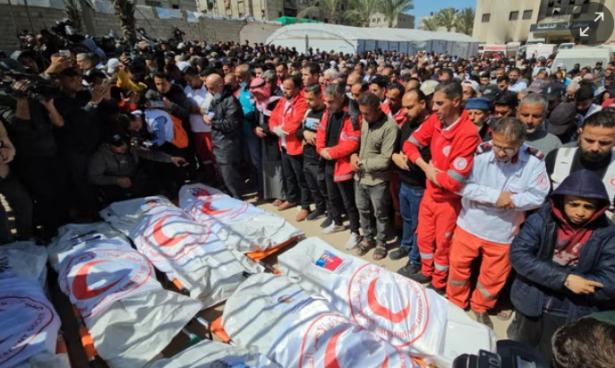
Funerals held at Nasser hospital in Khan Younis for eight of the Palestinian Red Crescent Society health workers shot dead by Israeli forces.,Photograph: APA Images/Rex // The Guardian
A forensic doctor who examined the bodies of some of the 15 paramedics and Palestinian rescue workers shot dead by Israeli forces and buried in a mass grave in southern Gaza has said there is evidence of execution-style killing, based on the “specific and intentional” location of shots at close range.
The Palestinian Red Crescent Society, the Palestinian Civil Defense and UN employees were on a humanitarian mission to collect dead and wounded civilians outside the southern city of Rafah on the morning of 23 March when they were killed and then buried in the sand by a bulldozer alongside their flattened vehicles, according to the UN.
Israel has expanded its aerial and ground attacks in Gaza since ending the ceasefire last month. The prime minister, Benjamin Netanyahu, said on Wednesday it intends to “divide up” the territory.
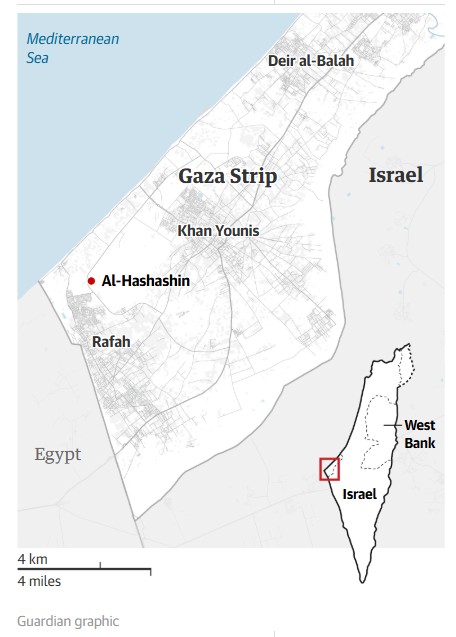
The killing of the paramedics and rescue workers has triggered outrage around the world and demands for accountability. On Wednesday, the UK foreign secretary, David Lammy, said Gaza was the deadliest place on Earth for humanitarian workers.
“Recent aid worker deaths are a stark reminder. Those responsible must be held accountable,” Lammy said.
Ahmad Dhaher, a forensic consultant who examined five of the dead at Nasser hospital in Khan Younis after they had been exhumed, said all of them had died from bullet wounds. “All cases had been shot with multiple bullets, except for one, which could not be determined due to the body being mutilated by animals like dogs, leaving it almost as just a skeleton,” Dhaher told the Guardian.
“Preliminary analysis suggests they were executed, not from a distant range, since the locations of the bullet wounds were specific and intentional,” he said. “One observation is that the bullets were aimed at one person’s head, another at their heart, and a third person had been shot with six or seven bullets in the torso.”
He emphasised that there was room for uncertainty due to the decomposition of the remains, and that in other cases he reviewed “most of the bullets targeted the joints, such as the shoulder, elbow, ankle, or wrist”.
Two witnesses to the recovery of the bodies told the Guardian on Tuesday that they had seen bodies the hands and legs of which had been tied, suggesting they had been detained before their deaths. A Red Crescent spokesperson, Nebal Farsakh, said on Wednesday that one of the paramedics “had his hands tied together with his legs to his body”.
Dhaher said there was no clear evidence of restraints on the five bodies he examined. “I could not recognise any tying marks on their hands due to the state of decomposition of the five cases I checked, so I can’t be sure of it,” he said.
The Israel Defense Forces and Benjamin Netanyahu’s government have said IDF soldiers opened fire on the ambulances and rescue vehicles because they were “advancing suspiciously toward IDF troops without headlights or emergency signals”. Government officials claimed to have killed a Hamas military operative they named as Mohammad Amin Ibrahim Shubaki, and “eight other terrorists” from Hamas and Palestinian Islamic Jihad, in the attack on 23 March.
However, Shubaki was not among the bodies recovered from the mass grave outside Rafah on Saturday and Sunday, eight of which were identified as Red Crescent ambulance workers, six as civil defence rescue workers, and one as an employee of the UN relief agency Unrwa. The IDF has not responded to questions about why the dead were buried with their vehicles or to reports that some showed signs of having been tied up.
The sole survivor from the shootings on 23 March, Munther Abed, a Red Crescent volunteer, contradicted the official Israeli account, saying the ambulances had been observing safety protocols when they were attacked.
“During day and at night, it’s the same: external and internal lights are on. Everything tells you it’s an ambulance that belongs to the Palestinian Red Crescent. All the lights were on until we came under direct fire,” Abed told The World at One on BBC Radio 4. He denied that anyone from a militant group was in the ambulance.
Abed, who was in the first ambulance to come under fire in the early morning of 23 March, said he survived because he threw himself to the floor at the back of the vehicle when the shooting started. The two paramedics in the front seats of the ambulance were killed in the hail of Israeli gunfire. Abed was detained and interrogated by Israeli soldiers before being released.
The other 13 victims were all in a five-vehicle convoy dispatched some hours later to recover the bodies of the two dead ambulance workers. All of them were shot dead and buried in the same grave.
A Guardian investigation published in February found that more than 1,000 medical staff had been killed across Gaza from the beginning of the conflict on 7 October 2023 – triggered by a Hamas attack on southern Israel that killed 1,200 Israelis – until the beginning of a temporary ceasefire in January. Many hospitals have been reduced to ruins in attacks that a UN Human Rights Council commission concluded amounted to war crimes.
Since ending the two-month ceasefire last month, Israel has vowed to step up its military campaign against Hamas. On Wednesday the defence minister, Israel Katz, said that campaign was expanding to “seize extensive territory” in the Gaza Strip. Netanyahu said Israel intended to build a new security corridor as it was “dividing up the Strip”.
Hospital officials in the occupied Palestinian territory said Israeli strikes overnight and on Wednesday had killed at least 40 people, nearly a dozen of them children.
What We Know About the Case of Gaza Aid Workers Killed by Israeli Gunfire
The Israeli military, confronted with video evidence contradicting its initial account, now says it was “mistaken.”
The Israeli military has acknowledged flaws in its initial accounts of its troops’ involvement in the killing last month of 15 people in southern Gaza who the United Nations said were all paramedics and rescue workers.
The admission came on Saturday, the day after a video obtained by The New York Times appeared to contradict a key part of the military’s earlier version of events. While the military had said it fired on the vehicles after they “advanced suspiciously,” the video showed clearly marked ambulances and a fire truck.
The episode has drawn international scrutiny and condemnation. After the blatant inconsistencies in the Israeli account were revealed, the military seemed to move more quickly than usual to address the issue. Internal military inquiries into questionable deadly episodes can drag on for months, even years.
Here’s what we know so far:
The Israeli military’s version(s)
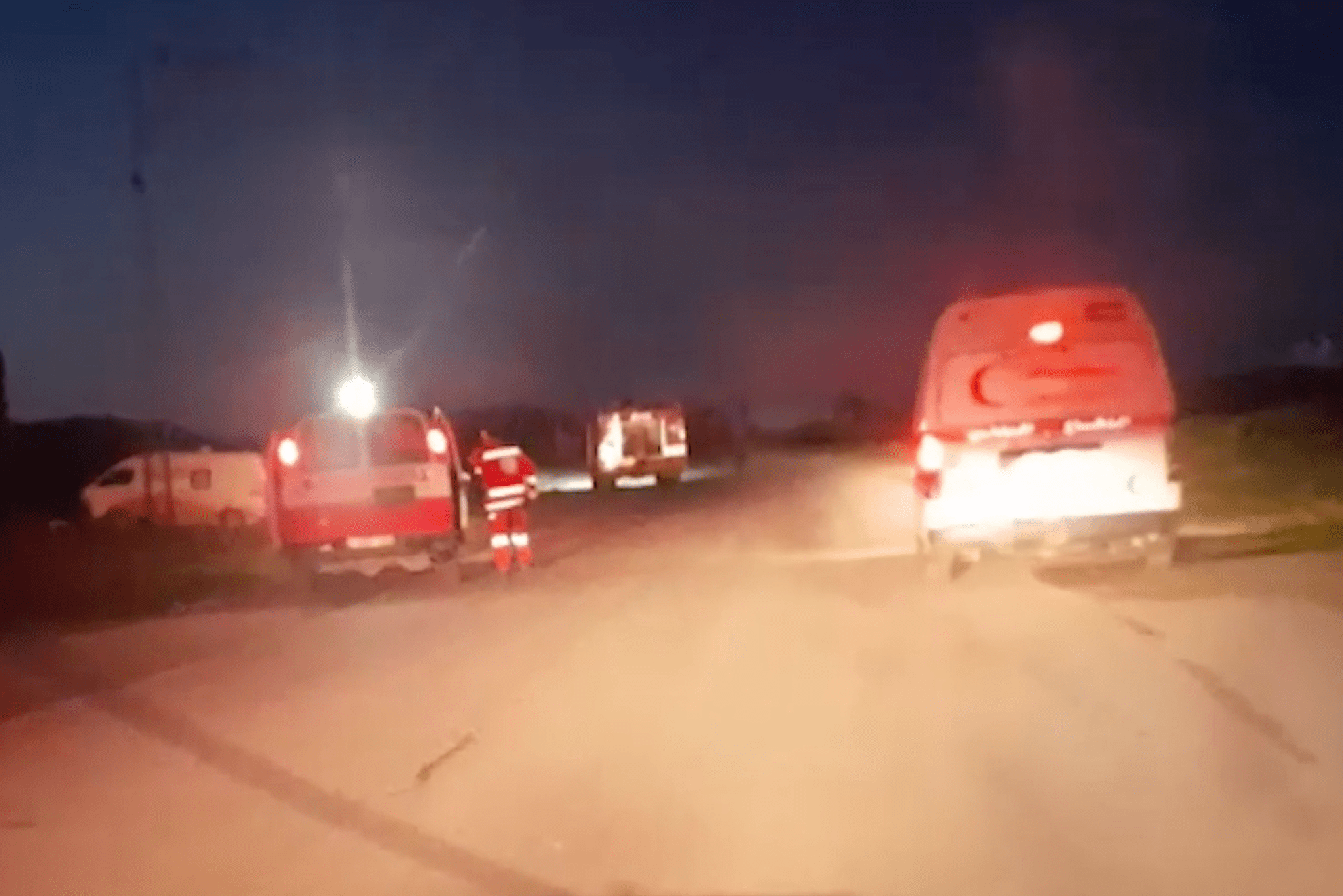
In its initial statements after the bodies were discovered, the military insisted its troops had opened fire as a convoy approached them in the dark “without headlights or emergency signals.”
But the video — discovered on the cellphone of a paramedic who was found in a mass grave — shows that the ambulances and fire truck had emergency lights on as Israeli forces unleashed their barrage.
The military now says the initial account from forces on the ground was “mistaken.”
Military officials had previously asserted that nine of those killed were operatives of Hamas or Islamic Jihad. They had named only one of the nine and provided no evidence for their claim.
On Saturday, a military official who briefed reporters on the initial findings of an internal inquiry said at least six of the 15 were Hamas operatives but still did not provide evidence. The official spoke on the condition of anonymity under army rules.
Before the encounter with the emergency vehicles, the official said, reserve forces from an infantry brigade had been lying in ambush along a road to the north of the Gazan city of Rafah before dawn on March 23. At 4 a.m., they killed what the official described as two Hamas security personnel and detained a third.
Two hours later, as dawn was breaking, the emergency convoy approached the same spot. When the rescue workers began to leave their vehicles, the official said, the Israeli forces believed that they were Hamas operatives heading for them and opened fire from afar.
Amos Harel, a military affairs analyst for the left-leaning newspaper Haaretz, said in an interview that the soldiers had “good reason to be anxious” and that it would be wrong to assume immediately that the case was one of “murder in cold blood,” citing Hamas fighters’ frequent use of civilian infrastructure as cover.
But the episode raises questions, Mr. Harel said, about the soldiers’ conduct and the version of events they reported from the ground.
The military official denied reports that some of the bodies were found bound and shot at close range. He said that the troops had buried the bodies to shield them from wild animals and used heavy equipment to move the disabled vehicles off the road, mangling them.
What the aid groups say
Palestine Red Crescent Society representatives said last week that ambulances had set out around 3:30 a.m. on March 23 to evacuate Palestinian civilians wounded by Israeli shelling.
The Red Crescent said that an ambulance and its crew had been hit by Israeli forces and that several more ambulances and a fire truck headed to the scene over the next few hours to rescue them. A U.N. vehicle was also sent, the United Nations said.
Seventeen people were dispatched in total, of whom 10 were Red Crescent workers, six were emergency responders from Gaza’s civil defense service and one was a U.N. worker.
It took days to negotiate access to retrieve the 15 bodies. The Red Crescent said that one medic was still missing and that one had been detained by Israeli forces and later released.
The Red Crescent said Israel’s “targeting” of its medics should be “considered a war crime” and demanded an investigation. It added that the latest killings brought to 27 the number of its members killed during the war, which started on Oct. 7, 2023, with a deadly Hamas-led attack on southern Israel.
On Friday, the president of the Palestine Red Crescent Society, Dr. Younis Al-Khatib, told reporters that, based on autopsies and forensic evidence, the emergency workers had been “targeted from a very close range.”
Reaction in Israel so far
The case has received broader coverage in Israel since the exposure of the video. Politicians have mostly remained silent, perhaps waiting for the military to complete its inquiry.
Mr. Harel, the military affairs analyst, said the inquiry was a first test for the recently installed military chief of staff, Lt. Gen. Eyal Zamir, regarding the military’s international standing.
And the larger question of accountability remains. Yesh Din, an Israeli human rights organization, found last year that of 573 cases of suspected war crimes in Gaza examined over the past decade by the army, only one led to prosecution.
Follow this link to the original New York Times article:
